

If you only do one tubing trip in Florida, make it the Ichetucknee. This state park is a National Natural Landmark fed by 8 major springs that combine to form six miles of clear, cool Ichetucknee River water. It is two parks in one: the South Entrance for tubing, and the North Entrance for swimming, snorkeling, and diving.
We did the full combo in July of 2026: two tubing laps from the South Entrance in the morning, a midday detour to three nearby Suwannee River springs, and ended our day back at the North Entrance with a Headspring and Blue Hole swim. This guide covers everything you need to plan the same kind of full-day adventure, even during the busy summer season, or a simpler half-day tubing trip at my favorite river in Florida.
Quick Facts
- Location: Fort White, FL, near High Springs
- Water Temp: 72°F year-round
- Entrance Fee: $6 per vehicle (2-8 people)
- Hours: 8 am until sundown daily (tubing and rental cutoffs are earlier)
- Activities: Tubing, kayaking, canoeing, paddleboarding, swimming, snorkeling, cavern/cave diving, hiking, picnicking, wildlife watching
- Wildlife: Alligators, river otters, beavers, gar, turtles, birds
- Best For: Tubing, Snorkeling, Swimming, anchor for Suwannee spring-hopping
- Official Website: Ichetucknee Springs State Park
South Entrance vs. North Entrance: Which Should You Visit?
The most important thing to understand before visiting is that the two entrances offer completely different experiences. If you line up at the wrong one on a busy summer day, you could miss your tubing window.
South Entrance: Tubing and Paddling. This is where you’ll find Dampier’s Landing, the tram, the General Store, tube and boat rentals, the Educational Center, and the takeout points. If you’re tubing the Ichetucknee, this is the entrance you need.
North Entrance: Headspring, Blue Hole, and Hiking. This is a separate parking area, accessed from an entirely different road. It’s where you swim and snorkel the Ichetucknee Headspring, hike to Blue Hole, and start the nature trails. To protect swimmers and snorkelers, no tubing is allowed here.
The two lots are not connected, so if you want to do both in one day, plan on driving between them on public roads. If you want to experience both, I recommend tubing first and swimming second.
Overview
Ichetucknee Springs State Park is 2,669 acres along one of the most pristine spring runs left in the state. The Headspring itself is a National Natural Landmark, and the river it starts is one of the best tubing rivers in Florida. The water is unbelievably clear, the canopy is dense enough to shade you, and the current does all the work.
Midpoint Tube Launch Closure: As of July 2026, the midpoint tube launch has been closed since March 2026 for repairs, with no announced reopening date. Every tuber is launching from Dampier’s Landing at the South Entrance. You can still tube as many times as you want, but the loop is shorter (around an hour). Make sure to check the park’s website for current closure status.
Who Should Visit Ichetucknee Springs State Park?
Ichetucknee Springs is a great fit for almost anyone who enjoys clear water and outdoor activities, but different visitors will enjoy different parts of the park.
Tubers: The South Entrance offers one of Florida’s best tubing experiences, with a gentle current, cool water, heavy shade, and very little effort required.
Families: The tubing run and Headspring are generally the easiest areas for a family day, although summer crowds can make the experience feel busy.
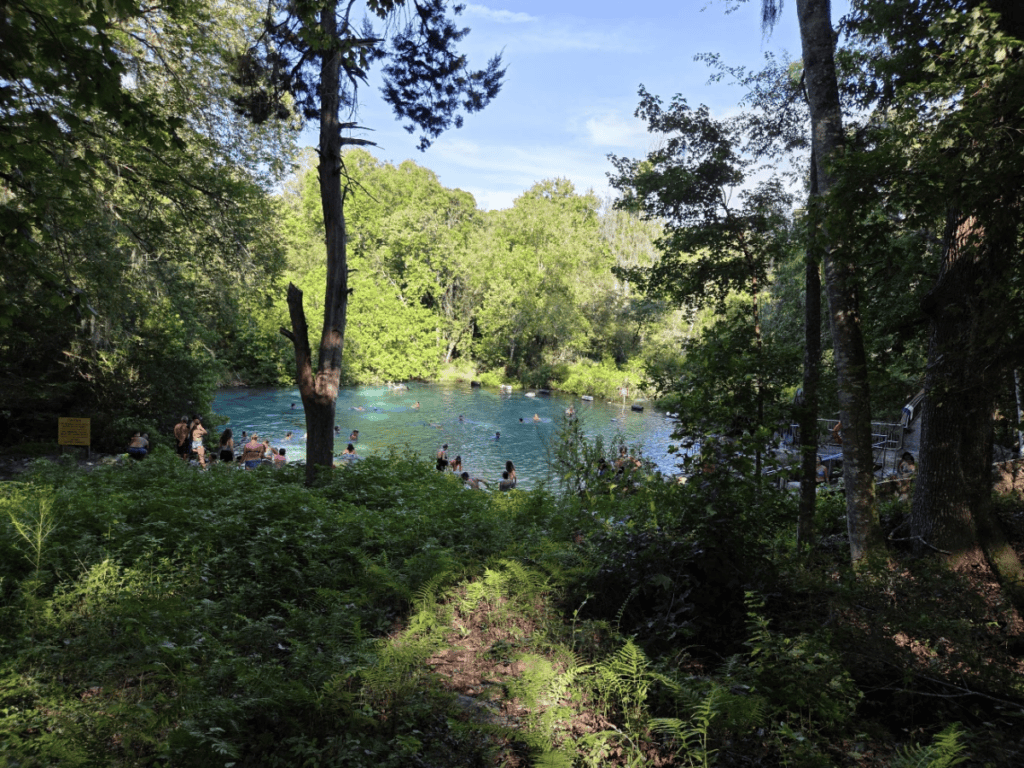
Swimmers and snorkelers: Headspring is the easiest choice for swimming and snorkeling, while Blue Hole offers a deeper and more dramatic experience for confident swimmers.
Divers: Blue Hole is a unique cavern and cave-diving destination for properly certified divers.
Paddlers: Kayakers, canoeists, and paddleboarders can experience more of the river than tubers and have a quieter, slower trip.
Hikers and wildlife watchers: The North Entrance trails are short but worthwhile, particularly if you want a break from the water.
Who Should Skip It?
Ichetucknee may not be the best choice if you dislike crowds, cold water, or planning around capacity limits.
I would especially reconsider a summer weekend visit if you want a quiet, natural experience. The river can become extremely crowded, and capacity closures can make the day unpredictable.
You may also prefer another Florida spring if you want a resort-style experience with extensive food, lodging, and amenities directly on-site. Ichetucknee is best approached as an outdoor destination rather than a polished attraction.
Things to Do at Ichetucknee Springs State Park
The highlights at Ichetucknee Springs are tubing, swimming/snorkeling, cave diving (if properly certified), paddling, hiking, and wildlife watching.
Tubing at Ichetucknee (South Entrance)
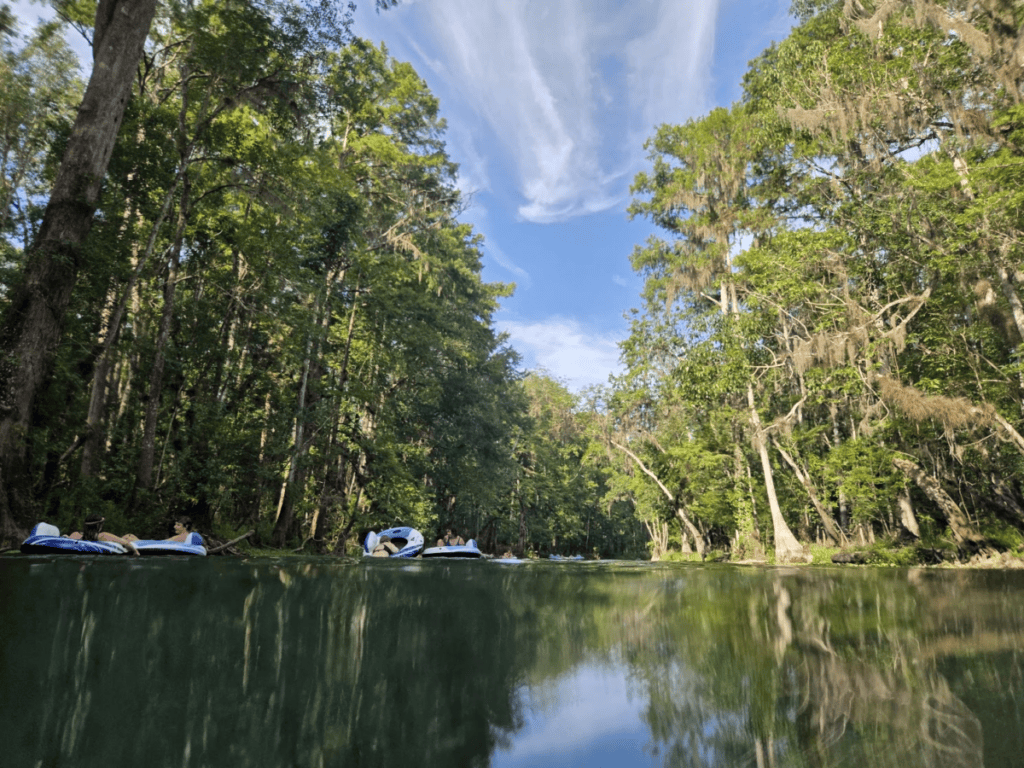
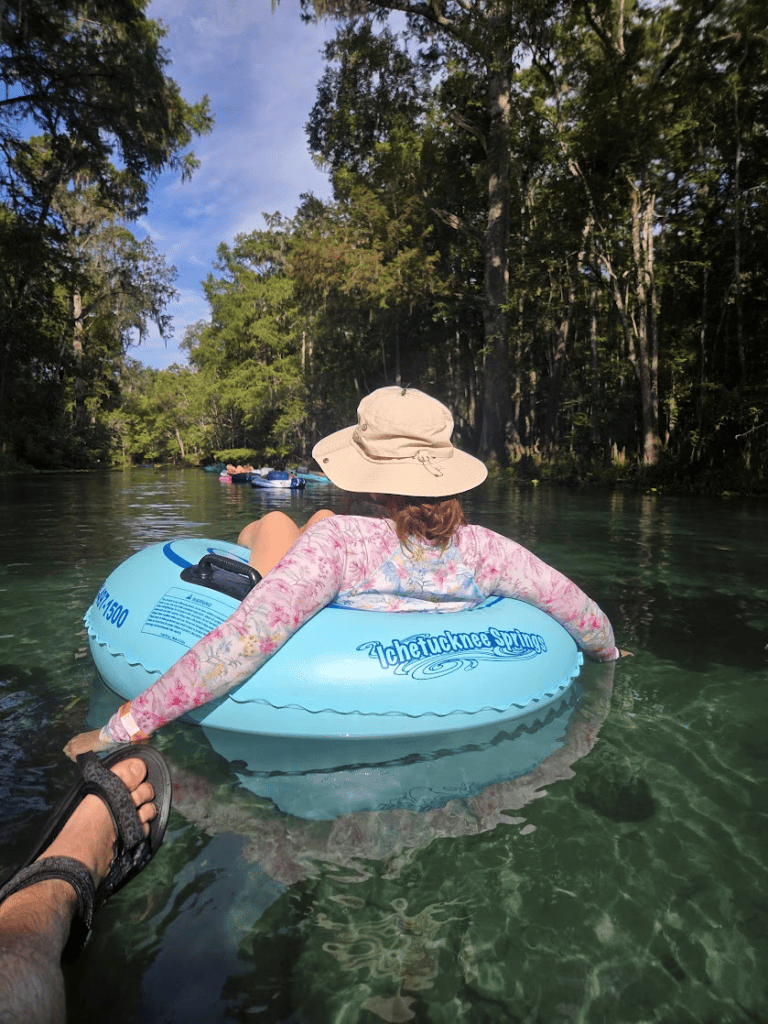
This is the main reason to drive out to the Ichetucknee, and it’s my favorite tubing trip in Florida. From Dampier’s Landing (or Midpoint if it’s open), the current carries you downriver for about an hour under a canopy of massive trees. The water is so clear that you can watch fish and turtles below you for most of the run, and the river stays around 72-73°F year-round regardless of air temperature.
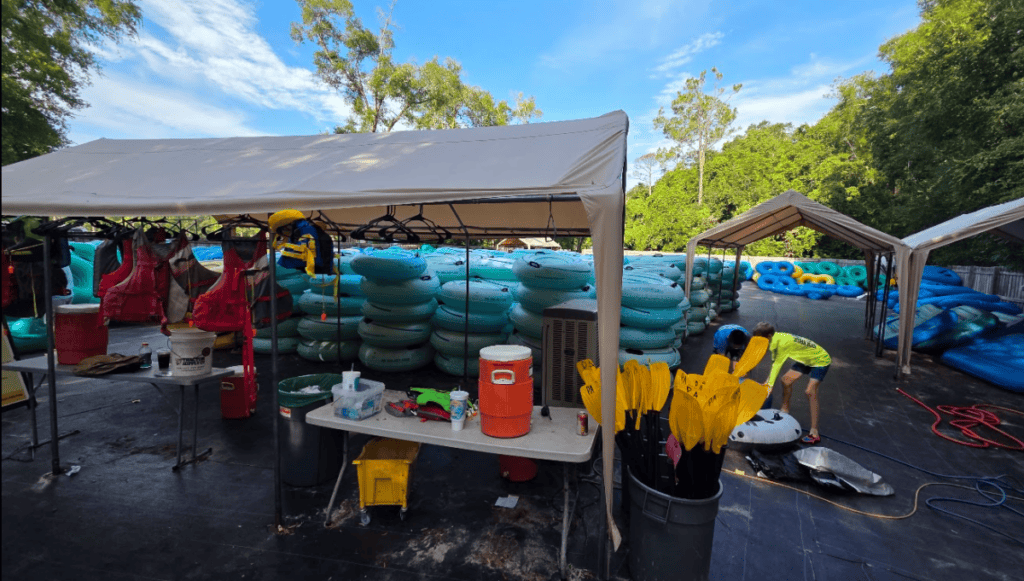
There is no cap on the number of times you can do the tube run. You can float it, tram back, and go again to your heart’s content. The only restriction is that tube rentals generally stop at 4:30PM, and all rented tubes must be returned by 6PM, when the tram stops running.
Bring your own tube if you can. here have historically been outside tube vendors in the area, but I did not see any operating along Highways 27 or 238 during our July 2026 visit. The park does rent tubes, and the process was relatively smooth, although renting adds time to the start of your day. Tubes cannot exceed 60 inches in both length and width, but large dual-person tubes and rafts are available for rental on-site.
Swimming at Ichetucknee Springs State Park
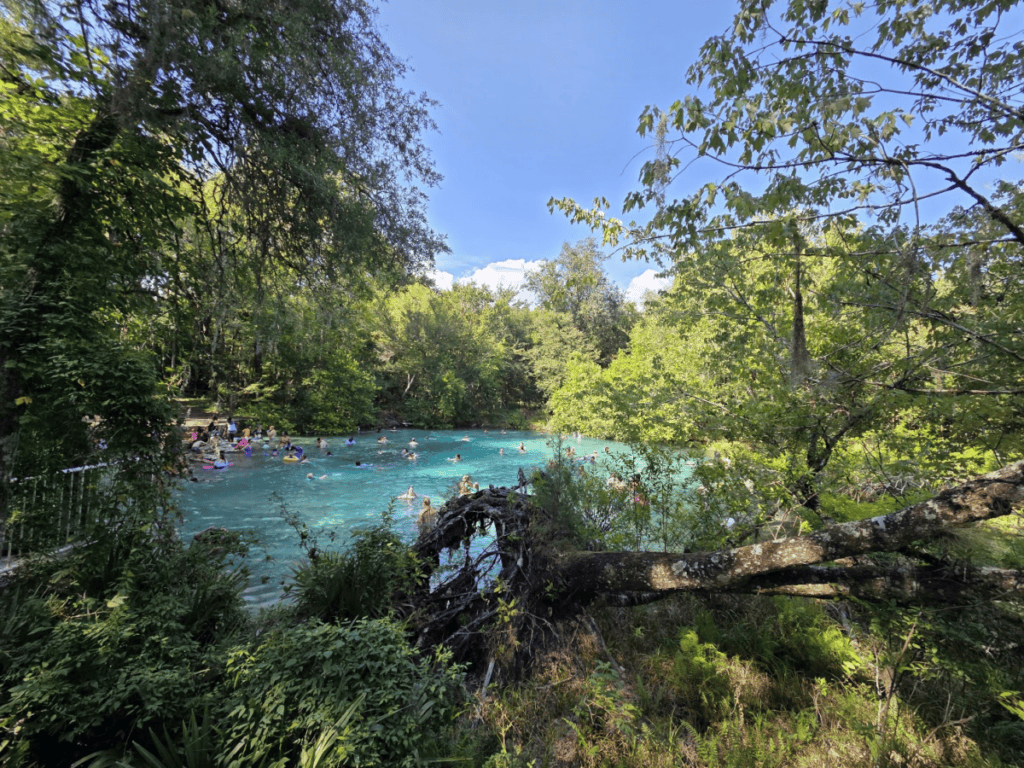
The Ichetucknee Headspring and Blue Hole are entirely different from the tube run, and most people skip them without realizing what they are missing.
Headspring is the gentler of the two. It is a shallow, family-friendly second-magnitude spring pumping millions of gallons a day. The visibility here rivals anywhere in the state (except for maybe Silver Glen Springs). Make sure to bring a mask and snorkel.
Blue Hole is a half-mile hike from the North parking lot on a rooty trail, but it’s worth the hike. This first-magnitude spring is deep, fast, and dramatic. The outflow is fast, and it’s best suited to strong swimmers. There is no gradual entry, so weaker swimmers should use extra caution. Pool noodles and life jackets are permitted for flotation at the swimming areas; check current park rules before bringing other flotation devices.
Diving Blue Hole
Blue Hole is a recognized cave/cavern dive site. You need to be cave or cavern certified to enter the cave system, and you should be prepared to carry your gear roughly a half-mile to Blue Hole. The park requires dive parties of at least two divers, and dives must be completed one hour before sunset. Do not attempt to enter the overhead cave environment without the appropriate cave-diving certification and training. You can get a good view of the inside of the Blue Hole without entering into the hole/overhead environment.
Kayaking and Paddling
Paddling the Ichetucknee provides a different experience from tubing it. Kayaking or paddleboarding it is slower, quieter, and you can cover more ground. Canoes, kayaks, and paddleboards can launch from the North Boat Launch or Dampier’s Landing, and the concessionaire offers rentals and transportation options. (check https://ichetuckneesprings.com/ichetucknee-springs/plan-your-day/kayaking/ for more details).
Best Time to Visit
Summer (Memorial Day through Labor Day) is peak tubing season and has the heaviest crowds. The water feels great when the air is brutally hot, but you need to arrive early. The park can close to additional visitors when it reaches capacity, which is a real possibility on busy summer weekends and holidays.
Fall and winter are probably the best for swimming, diving, and hiking. The 72°F water feels warm against the cool air, trails are more comfortable, crowds thin out, and a ranger told us that we might even see some manatees when the river is high enough and the air is cold enough.
Weekdays year-round are less crowded than weekends. If possible, try to visit on a weekday.
Entrance Fees, Hours, and Reservations
Admission (same at both entrances):
- $6 per vehicle, 2-8 people
- $4 single-occupant vehicle
- $4 motorcycle (one or two people)
- $2 pedestrians, cyclists, extra passengers
To ride the tram, you will need to purchase a wristband at the concession facility. In summer of 2026 it was $7.50/person. Rental fees depend on tube size, and regular tubes were $10/tube to rent.
Hours: 8 am to sundown daily. Tube rentals end at 4:30 pm; the last tube launch from Dampier’s Landing is 5 pm The tram runs 8 am to 6 pm
Reservations: Advance reservations for tubing and paddling are strongly encouraged. They allow you to reserve your equipment or river experience and complete the required liability waiver in advance. However, a tubing or paddling reservation does not guarantee admission to the state park or allow you to bypass the entrance line. Park admission is separate, and the park may close to all visitors when it reaches capacity.
We completed our tubing reservation while waiting in line at the South Entrance after realizing the park was likely to reach capacity.
Capacity closures are real. As of our July 2026 visit, the park temporarily closed to additional visitors (including reservation holders and digital day-pass holders) once it reached capacity. Rangers can cite anyone caught parking and waiting along the road for it to reopen. Don’t plan on that as a backup strategy.
How to Get There
- South Entrance: 12087 SW US Hwy 27, Fort White, FL 32038 — from I-75, take exit 399 and follow US 441/27 north toward Fort White.
- North Entrance: 8294 SW Elim Church Road, Fort White, FL 32038 — from I-75, take exit 423, follow SR 47 south, then CR 238 and the park signs.
The two entrances are roughly a ten-minute drive apart on local roads and are not connected inside the park, so budget for that if you’re doing both in one visit On busy summer weekends, the other entrance may also be at capacity by the time you leave the first one, so plan to visit nearby springs or eat lunch in town if you cannot enter.
What to Bring
This park is one of the larger ones, so I would recommend bringing the following:
- Water shoes or sandals with a strap, like Chacos or Tevas (the tube run entry and Blue Hole trail both have rocks and roots)
- Swimsuit (including SPF swim shirt if you’re looking to spend all day on the water)
- Your own tube if you have one
- Mineral (reef-safe) sunscreen
- Mask and snorkel
- Dry bag for your phone and keys
- Towels
- Water and snacks — you’ll want more than you think for a full spring-hopping day
- Cash or card for tube rentals and park entry
- Bug spray if you plan to hike
Leave at home: alcohol (prohibited on the river and in the park), glass containers, and tobacco products on the river.
Tips to Avoid Crowds

In the summer, there is not really a way to avoid crowds. While you can’t prevent them, here are some tactics that can help to ease them:
- Arrive right at 8 am, or even 7:30am in May through September. Capacity fills early in the summer weekends.
- Visit on a weekday. Ichetucknee gets slammed on summer weekends and holidays and weekdays are a little easier.
- Go in fall or winter for swimming and the trails specifically (the tubing crowd mostly disappears when summer ends)
- Do the North Entrance in the late afternoon. We found it noticeably quieter after 4 pm, which is exactly why we saved Headspring and Blue Hole for last.
- Reserve your tube or paddle gear in advance to skip a line at the General Store.
- Don’t plan to wait roadside for capacity to reopen. You may get turned away and cited.
Where to Stay Nearby
There’s no camping inside Ichetucknee Springs State Park itself. For a base camp, Fort White has a handful of private campgrounds and cabin outfits built specifically around river access.
My choice would be to stay at an Airbnb in High Springs. This charming small town is around 30 minutes away and also has a better selection of restaurants.
Though slightly further out, Lake City and Gainesville offer additional options for lodging.
Nearby Things to Do
The Ichetucknee sits in the middle of one of the best spring clusters in Florida, so it works well as an anchor for Springsmaxxing.
Other Springs Near Ichetucknee Springs State Park
If you are visiting from another part of Central Florida, I would not make the drive to Ichetucknee just to spend two hours tubing and immediately turn around. The surrounding spring corridor is too good to skip.
There are a lot of springs on the Suwannee and Sante Fe Rivers, but these are the closest and make for a full day of spring-hopping:
- Little River Springs (Suwannee County, near O’Brien, about 25 minutes away): A 125-acre county park on the Suwannee River with a 150-foot spring run and a 1,200-foot cave system for certified divers. Shallow areas make it kid-friendly, and it’s a great spot to see clear spring water meet the tannin-stained Suwannee side by side. $5 per vehicle.
- Ruth Springs (Ruth Springs Tract, off CR 421 near Branford/Mayo, about 30 minutes away): This one’s the undeveloped option: a small, mostly primitive swimming hole within the Suwannee River Water Management District’s Ruth Springs Tract. There are no real amenities, and generally few other visitors. Stop here for a low-key break between major springs.
- Troy Springs State Park (Branford, about 30 minutes away): A dramatic first-magnitude spring, 70 feet deep, holding the remains of the Civil War-era steamboat Madison on its floor. Great for snorkeling and open-water diving, with a short nature trail and actual facilities (restrooms, picnic tables, and a dock). $5 per vehicle.
If you want to extend the corridor further, Rum Island Park, Gilchrist Blue Springs State Park, and Ginnie Springs are all a reasonable drive up toward High Springs and worth their own trip.
Hiking Trails Near Ichetucknee Springs State Park
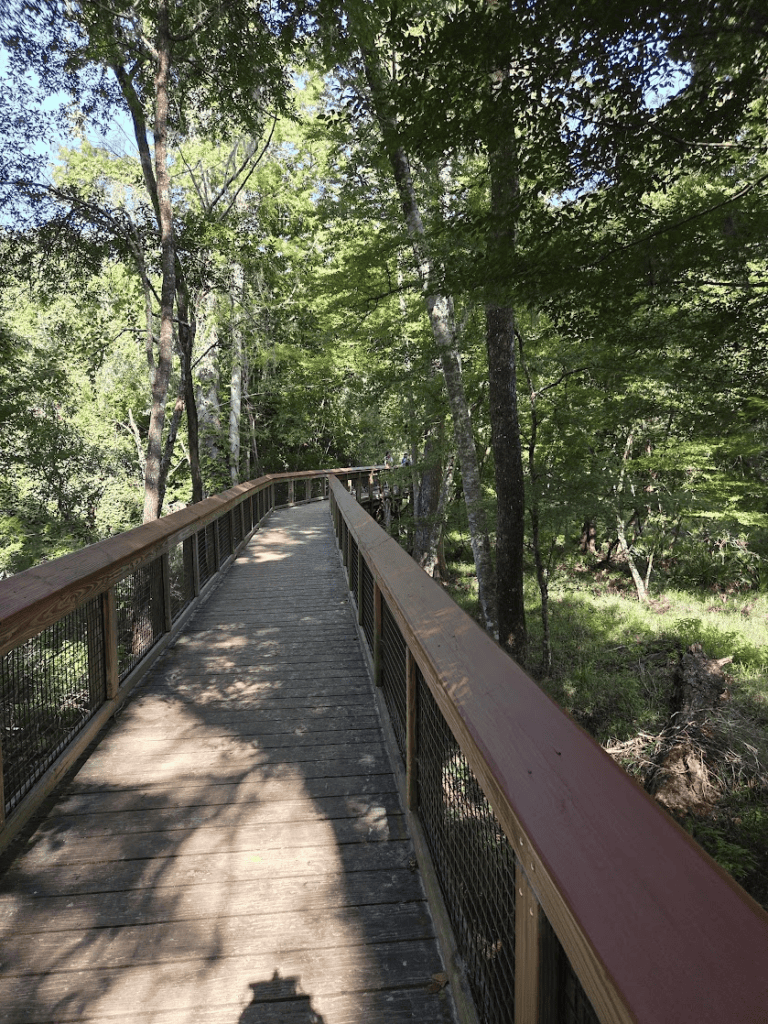
All three trails start from the North Entrance:
- Blue Hole Trail (about 1 mile round trip, easy): Sandy and root-crossed, leading to the overlook and dive platform at Blue Hole. Worth walking even if you’re not swimming there.
- Trestle Point Trail (roughly 0.75 miles, easy): This trail follows the river through shaded forest and connects visitors with the area’s early-20th-century phosphate-mining history.
- Pine Ridge Loop (adds about 2 miles, easy): Branches off Trestle Point into pine flatwoods for a change of scenery from the shaded riverside sections.
Restaurants Near Ichetucknee Springs State Park

Options directly around Fort White are casual and food-truck heavy. Favorites are Shaun’s Kountry Kitchen for breakfast burritos and The Collective Food Yard and Garden, a small food truck park.
For lunch inside the park itself, The South Entrance has a full-service concession and restaurant, while the North Entrance has seasonal food service at the Riverside Grill. Hours can change, so check before relying on either for a meal.
For a sit-down meal, head toward Branford (Our Place Pizzeria & Ristorante) or High Springs, which has the strongest food scene in the area with options like Great Outdoors Restaurant, Bev’s Better Burgers, and Pink Flamingo Diner.
Pros and Cons
Pros:
- One of the best tubing rivers in Florida, with clear water, shade, and minimal stress
- Two very different experiences (tubing vs. swimming/hiking) under one entrance fee
- 72°F water, every day of the year
- Anchors an outstanding spring-hopping corridor with many springs within 30 minutes
- Real wildlife diversity, including the possibility of seeing manatees in the winter
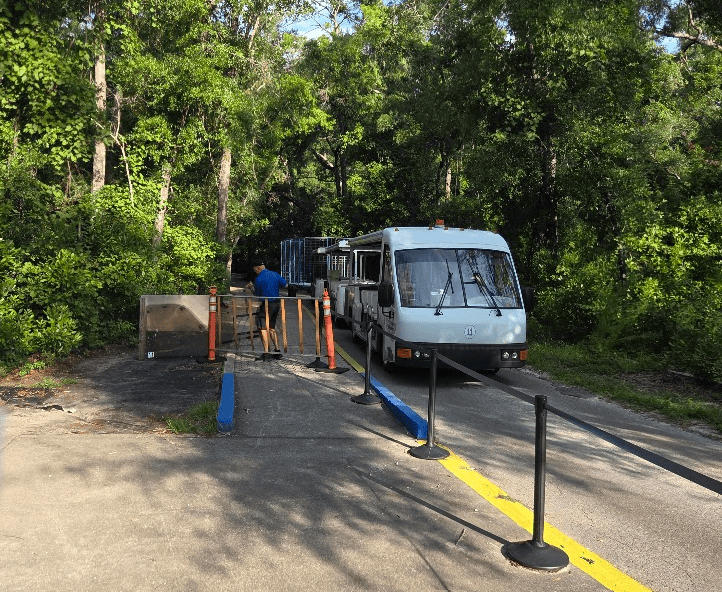
- Convenient tram and shuttle system on tubing days
Cons:
- Midpoint Tube Launch has been closed since March 2026, shortening the tubing run to a single repeatable loop for now
- Capacity closures are enforced hard in summer, and there’s no waiting it out roadside
- Very crowded in the summer
- North and South Entrances aren’t connected inside the park
- On-site dining is limited and grab-and-go
- No camping inside the park itself
Sample Itinerary
Quick-visit half day (South Entrance only):
- 7:45 am: Arrive at the South Entrance
- 8:15-9:15 am: First tube run from Dampier’s Landing
- 9:15-9:45 am: Tram back to the launch
- 9:45-10:45 am: Second tube run
- 11 am: Lunch at the General Store Grill, then head out before the midday crowds peak
Full Springsmaxxing day (what we actually did):
- 7:45 am: Arrive at the South Entrance
- 8-11 am: Two tubing runs from Dampier’s Landing
- 11:30 am: Grab a quick lunch and head out toward Little River Springs (about 25 minutes)
- 12-1:15 pm: Swim and snorkel Little River Springs
- 1:30 pm: Drive to the other side of the Suwanee River for Ruth and Troy Springs
- 2:00-2:30 pm: A quiet stop at Ruth Springs
- 2:45 pm: Troy Springs: snorkel over the wreck of the Madison and enjoy the deep spring
- 4:30 pm: Drive to Ichetucknee’s North Entrance
- 5-6:30 pm: Swim Headspring, hike to Blue Hole for a last cold plunge before sundown
How Much Time Do You Need?
You can visit Ichetucknee Springs State Park in anywhere from a few hours to a full day.
2 hours: Enough for one tubing run or a quick swim at the North Entrance springs.
Half day: Ideal for two tubing runs at the South Entrance, especially if you arrive early.
Full day: Visit the South Entrance for tubing in the morning, then drive to the North Entrance for Headspring, Blue Hole, and the trails.
Two days: Worth considering if you want to add Ginnie Springs, Poe Springs, Rum Island, or additional springs farther along the Suwannee River.
We fit tubing, three nearby springs, Headspring, and Blue Hole into one long day during our July 2026 visit. It was doable, but I would recommend a second day if you want to explore the broader High Springs and Suwannee River spring corridor without rushing.
Our Experience at Ichetucknee Springs State Park
Ichetucknee Springs is one of my favorites, and I’ve been coming for years. Here is our latest experience in July 2026 at the park:
South Entrance (Morning)
My wife and I got an early start and made our way up to Fort White. We got in line at the South Entrance at 7:45am, which turned out to be about perfect since we had time to apply sunscreen while we waited. There were many cars ahead of us in line, but we were clearly going to make it in before the cutoff. When the park opened, we checked in and got some souvenirs from the store.
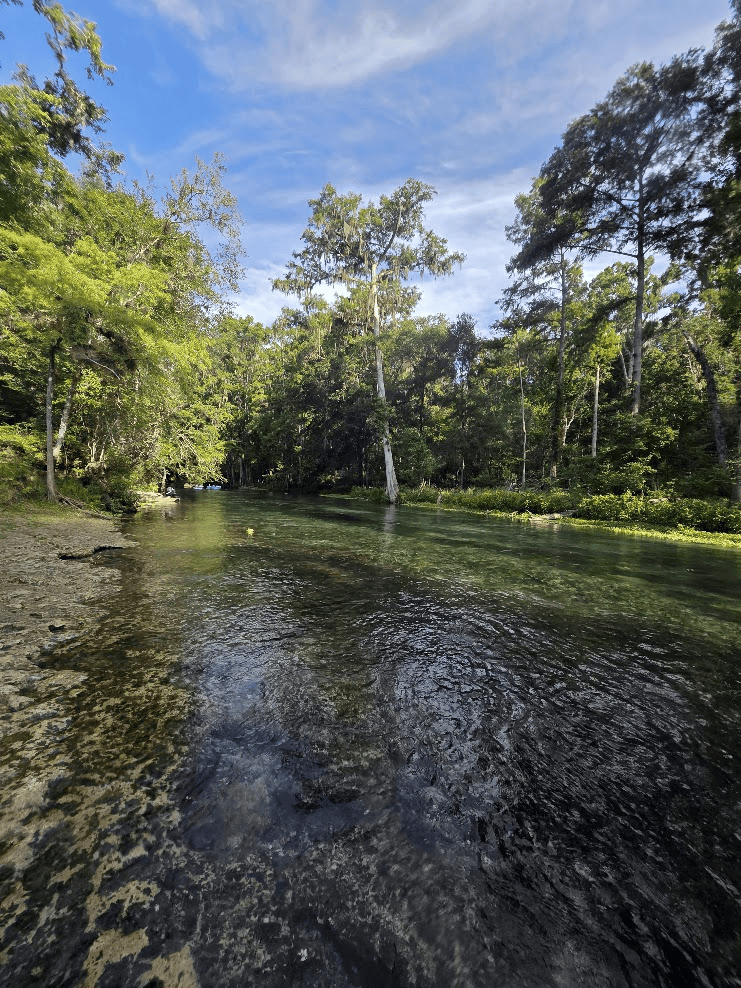
We grabbed our rental tubes and did the short hike to Dampier’s Landing. The water was cool and felt great as we started tubing. There were not a ton of people in the water yet, which let us enjoy the giant cypress trees and wildflower blooms.
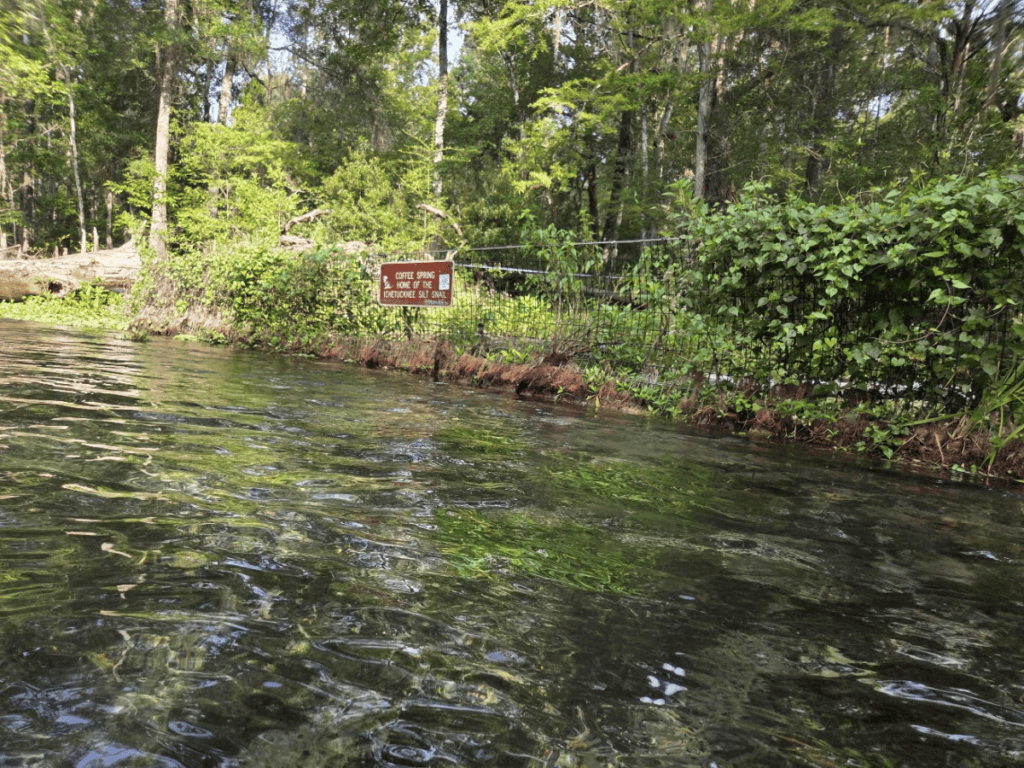
Before long, we hit Coffee Spring – Home of the Ichetucknee Silt Snail. This fenced-off spring is the only home of this endangered snail. If you remember from our Wekiwa Springs State Park Post about seeing a cave crayfish, the springs are home to a lot of endangered species and are one of the reasons they deserve protection.
After Coffee Spring, a dragonfly landed on my wife’s hat and rode along with us for a few hundred yards. We enjoyed the remaining float to the endpoint and departed. A tram arrived right on time, and the workers loaded our tubes for us before the ride back to the parking lot.
Back at the parking lot, we left to tube the run again.
On the second run, we saw a lot more people. Some groups were creating traffic jams on the river, which at points was bumper-to-bumper with tubes. Honestly, I kind of liked it. We saw the Ichetucknee River in a more natural state on the first run, so the second tube run added a kind of party atmosphere.
On our second tram ride back, I realized that there were Cut Leaf Coneflowers growing on the side of the tram road. These are one of the plants we emphasize and use in our Florida Native Plant Pollinator Garden.
Back at the parking lot, we ate a Philly cheesesteak and burger at the restaurant. They were pretty good for park food, which was good because they were also kind of pricey.
North Entrance (Evening)
After our morning at the South Entrance, we looped around to the North Entrance to try to get in for swimming. It was at capacity and there was a 50-car line, so we made our way west to the Suwannee River springs. We drove 30 minutes and visited Little River, Ruth, and Troy Springs State Park in the afternoon.
At around 4:30pm, we headed back to the North Entrance for a final attempt to get in. It was not at capacity, so we were able to park. We had kept our receipt from the South Entrance, and staff allowed us to enter the North Entrance without paying a second admission fee.
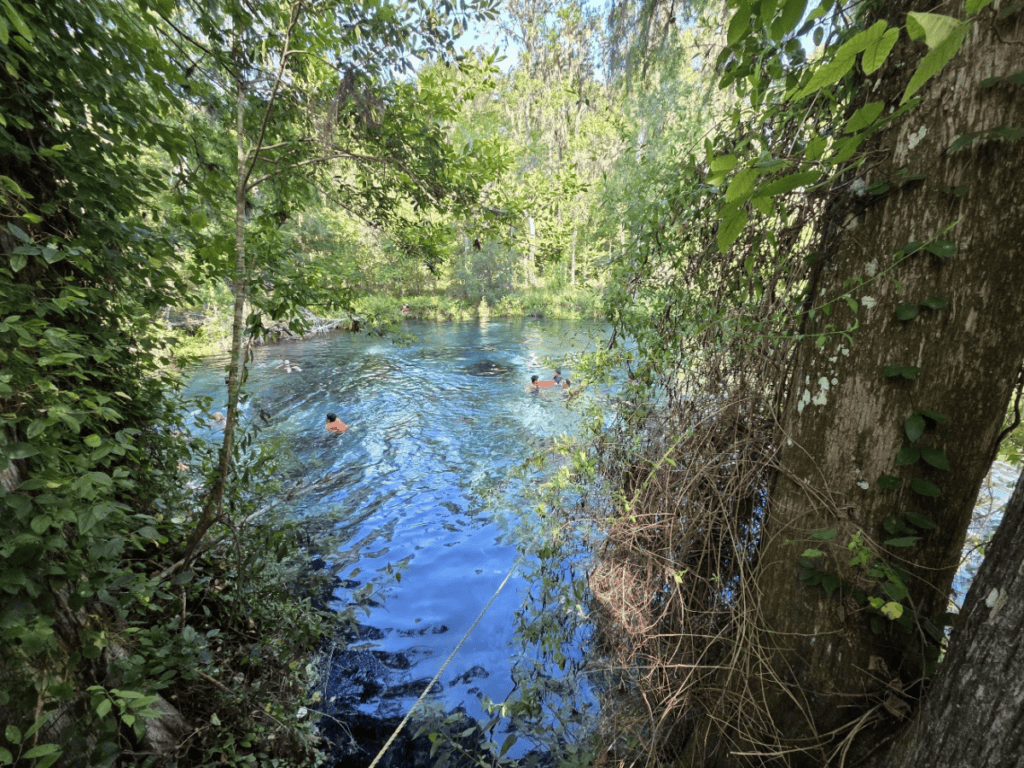
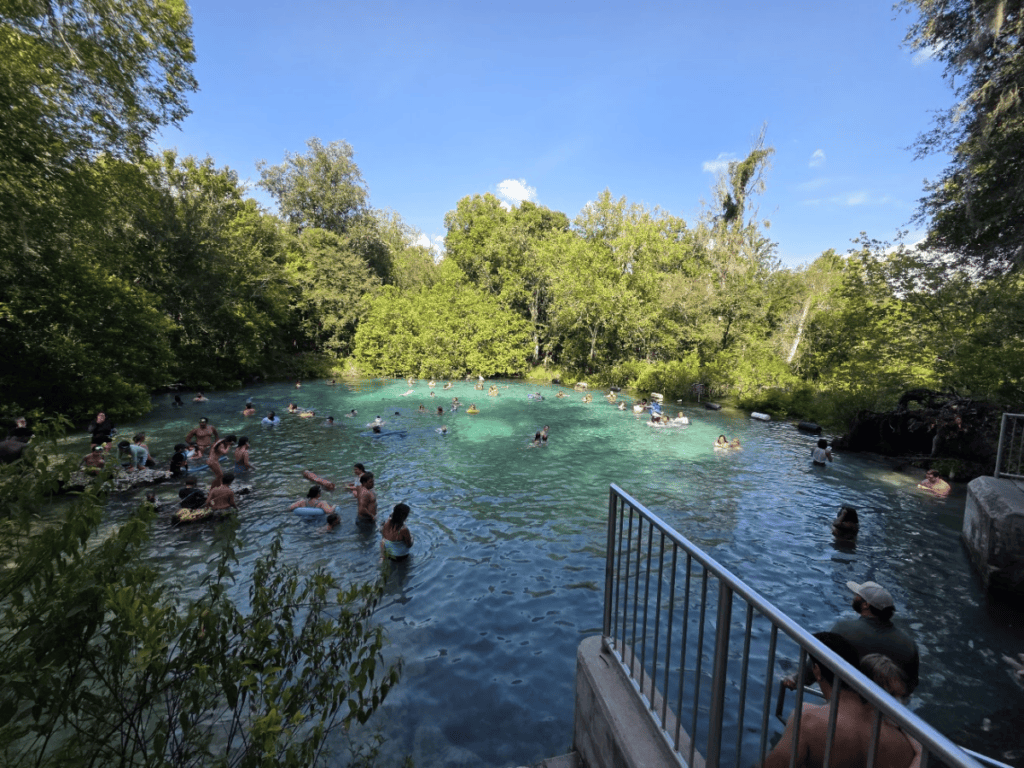
We started by swimming at the Headspring. The water was cool but crowded. We snorkeled the perimeter and swam down to see the vent. The water near the vent was still crystal-clear despite the crowds.
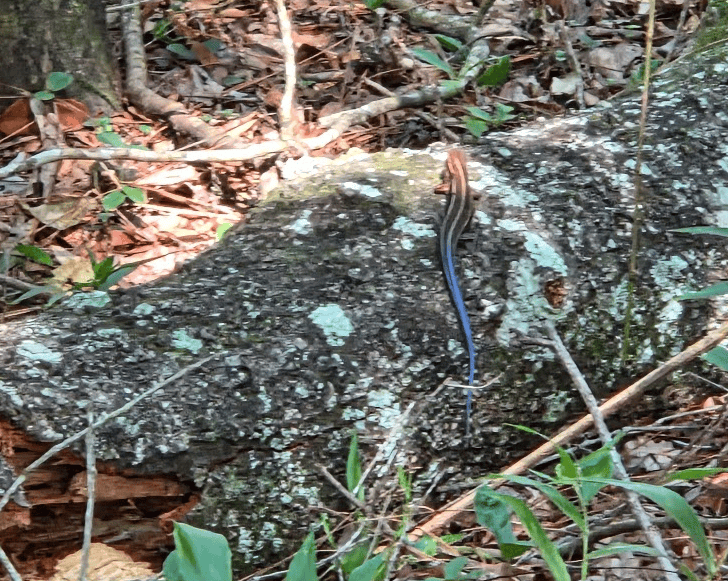
Next, we hiked the trail to the Blue Hole. There was a huge skink on the trail, which was around a half mile long and definitely felt like more after our long day of spring-hopping. The Blue Hole did not disappoint. The water was even more clear and bright blue than the Headspring, and slightly less crowded.
There were around 40 people on the small deck leading to the spring, but only 15 or 20 in the water. We swam and dove down to see the hole. The water was pumping out of the vent at a surprising pressure that felt equal to the one at Blue Spring State Park. I did not enter the hole since there was an overhead environment, but I was able to see that it opened up into a large room right below the entrance. I would love to hear the story on how the massive tree got to the bottom of the Blue Hole.
We hiked back to the parking lot and left, stopping in High Springs at the Florida Creamery ice cream to end our great day before heading home.
What We Would Do Differently
Visiting in July was a lot of fun, even with the crowds. To optimize the experience, I would return in the fall when the crowds die down to experience swimming with more water clarity. On a fall trip, I would like to paddle the river and hike the trails.
Frequently Asked Questions
Is Ichetucknee Springs State Park worth visiting?
Yes, without question. Between the tubing, Blue Hole, Headspring, and its position at the center of one of the best spring clusters in the state, it earns its reputation as one of Florida’s premier spring destinations.
Can you swim year-round?
Yes. The water is a constant 72°F, so it feels cool in summer and warm in winter. The park itself is open 365 days a year.
Are there alligators?
Yes, alligators are present in the park. Follow park rules, keep your distance from wildlife, and never approach or feed them.
Do you need reservations?
You do not strictly need a tubing or paddling reservation, but they are strongly encouraged. They let you reserve equipment and complete the liability waiver in advance. However, they do not guarantee admission to the state park or allow you to bypass the entrance line, and the park can close to all visitors at capacity.
Are there bathrooms available?
Yes, at both entrances.
What is the best spring to go tubing at?
Personally, I like Ichetucknee Springs State Park the best, with Rainbow Springs State Park as the runner-up. Third would be Rock Springs at Kelly Park, and I’d put Blue Springs State Park’s short run in last place.
Is the Midpoint Tube Launch open?
Not currently. It’s been closed since March 2026 for repairs with no announced reopening date, so all tubing currently launches from Dampier’s Landing at the South Entrance. Check the park website before your visit in case that’s changed.
Can you tube at the North Entrance?
No. Tubes are prohibited in both Headspring and Blue Hole to protect swimmers and snorkelers. The North Entrance is strictly a swim, snorkel, dive, and hike destination.
Can you visit Little River, Ruth, and Troy Springs the same day as Ichetucknee?
Yes, and we’d recommend it. All three are within about 30 minutes of the park, and the loop fits comfortably into a single long day if you get an early start on the tubing.
How cold is Ichetucknee Springs?
The water stays around 72°F year-round. That feels refreshing during a hot summer day but can feel surprisingly warm compared with the surrounding air during the fall and winter.
Is Ichetucknee Springs good for kids?
Yes, particularly the tubing run and Headspring. The tubing current is generally gentle, but parents should still supervise children closely. Blue Hole is deeper and has a more forceful outflow, making it better suited to confident swimmers.
Is Ichetucknee Springs good for non-swimmers?
Yes, although tubing and swimming are the park’s main attractions. You can hike the North Entrance trails, picnic, watch wildlife, or explore the park without getting in the water.
Can you bring your own tube to Ichetucknee Springs?
Yes. You can bring your own tube as long as it meets the park’s size restrictions. The park also rents tubes and other equipment.
How long is the Ichetucknee tubing run?
The current tubing route from Dampier’s Landing takes approximately an hour, although the exact time depends on water conditions, river traffic, and how often you stop along the way.
Is Ichetucknee Springs accessible for people with limited mobility?
The park has developed facilities, but many of the water access points, trails, and Blue Hole route involve uneven ground, roots, sand, or stairs. Visitors with mobility concerns should check current accessibility information before planning their visit.
What is the best month to visit Ichetucknee Springs?
For the fewest crowds, fall and winter are generally better than the peak summer tubing season. Summer offers the classic tubing experience but also brings the heaviest crowds and the greatest chance of capacity closures.
Final Thoughts
Ichetucknee Springs State Park is one of the best all-around spring destinations in Florida. The South Entrance gives you one of the state’s best tubing experiences, while the North Entrance offers clear-water swimming, snorkeling, Blue Hole, and short hiking trails.
The park is also perfectly positioned for a broader spring-hopping trip. Tube in the morning, explore nearby Suwannee River springs in the afternoon, and finish with a swim at Headspring or Blue Hole.
The main thing to plan around is summer capacity. Arrive early, visit on a weekday if possible, and have a backup plan if the park is full.
For the best overall experience, I would visit in the fall or winter, when the crowds are thinner and the weather is better for exploring the trails and surrounding springs. But if you want the classic Ichetucknee tubing experience, summer is still worth the crowds.
Leave a Reply