

This single habit makes healthy eating possible for busy people – here’s how to start this weekend.
In This Guide You’ll Learn
- Why meal prep is essential for healthy eating
- How to prep a week of meals in under 2 hours
- How to track calories and macros efficiently
- 3 high-protein meal prep recipes
- A simple Sunday system to start the week
Why Meal Prep Is the Missing Link
You’ve tried to eat healthier before – but when life gets busy, convenience wins. You started a diet with the best of intentions with clean breakfasts and healthy lunches. By the weekend you were exhausted and starved – and just ordered takeout again.
This is a design problem more than a willpower problem.
The people who consistently eat well, week after week through travel, long hours, and real life, all share one habit: they prep their food in advance.
Meal prep is not a fitness influencer trend. It is a practical solution to eating healthy, day in and day out, regardless of external circumstances. The fastest available option will be the healthy one.
If you’ve been following our framework for weight loss and performance by tracking calories, weighing daily, and building a habit of training, meal prep is the infrastructure layer that makes all of it easier to sustain. Calorie tracking will shift from a negotiation to a premade decision. It will remove the load of figuring out what to eat and when to cook.
This is how you make your system of health work long-term.
Benefits of Meal Prep
The benefits are numerous, but these are the ones that matter most: meal prep puts time back in your day, makes the right choice easy, and helps you hit your protein targets.
You Know Exactly What You’re Eating
The greatest benefit of meal prep is the calorie tracking advantage. When you prepare your food, you control every ingredient, and you can measure it. You know exactly what is in each container, so logging your repeated meals takes 10 seconds instead of guessing and research.
As we covered in our weight loss framework, most people underestimate calorie intake substantially. Eating prepped food is the most reliable way to close the gap. There are no hidden oils and butter sauces, no portion distortion, and no mystery calories. You weighed it all out on Sunday.
You Get Your Time Back
The math here is surprising to most people. A Sunday meal prep session of 2 hours (including dishes) produces food that covers 12 meals. The food is guaranteed to be there, you do not have to go out and buy ingredients.
As discussed in How To Get Your Time Back, the average American who is their household’s meal preparer spends 51 minutes per day preparing food and cleaning up. By meal prepping 2 meals per day every week, you will save 2.6 hours per week.
For the road trippers and busy professions this site is written for, that recovered time is essential. It is the difference between getting to bed on time or not, and between a calm and a frantic evening.
It Keeps You on Track While Traveling
If you’ve read our hotel gym workout guide and our guide to resuming training after a missed session, you already know that travel is where consistency dies. The same is true for food. Hotel dinners target flavor, not macros.
Meal prepped food travels. Meal prep services exist in many major cities. Prepped proteins and carbs survive in hotel room refrigerators. Your discipline at home raises your baseline, helping you to make better choices abroad.
You Stop Paying For Convenience
The average American spends over $3000 per year eating out for lunch alone – not counting dinners, coffee, or snacks. Batch-prepped meals contain whole food ingredients and high protein, you know what is in them, and they cost a fraction of what restaurants charge for the equivalent food.
Understanding the benefits is one thing – but making meal prep a success requires a system.
Core Principles for Effective Meal Prep
Before I hand over my recipes, here are the operational principles that make meal prep work for real people with really busy schedules.
Build Your Meal Around a Protein
Protein is the name of the game. Meal prep is the most effective way to hit your protein goal day in and day out, so start your meal by planning this. A single oven session can produce enough beef, chicken, fish, turkey, or venison for 6 days of meals.
Cook your protein in bulk, and pair it with different carbs and vegetables depending on what kind of mood you are in. Theoretically, you can use the same roasted chicken as a grain bowl, a salad, or a plate with roasted vegetables.
Pair a Carb and a Vegetable
I would recommend a single protein, a single carb, and multiple varieties of vegetables in each prepped container. You do not want to wash the dishes involved in cooking multiple proteins or carbs for the same meal, but vegetables are easy to vary.
Keep the Ingredients Real and Simple
Our philosophy on food is the fewer ingredients the better. Whole proteins, grains, and vegetables with minimal processing. All you need to make food taste good is olive oil, salt, spices, and lemon.
Buy organic if you can and use wild caught food if at all possible. We have great success in substituting venison for beef in steak and ground dishes.
Processed food is harder to track, denser, and easier to overeat. It generally has fewer vitamins and minerals per calorie. Your kitchen assembly line should be real food being cooked and placed into containers, not repackaging TV dinners.
Portion Into Containers Before Refrigerating
Your goal is to minimize friction. Chop up chicken and steak before placing it in containers. Portion everything out to be roughly equal by container. Each container is a meal – open it, heat it, eat it, and log it. Reduce decision making and let your brain work on your business and family, not food.
Use the same size containers for consistency. You can get a 6-pack of glass meal prep containers on Amazon for less than $30. Buy two sets: one each for lunches and dinners.
Do One Session Per Week
A single weekly meal prep session is sufficient. I recommend Sunday afternoon. On the way home from church, stop at the grocery store for ingredients. Before you start relaxing or going about your day, take care of meal prep. Block it off in your calendar the same way you would for a workout.
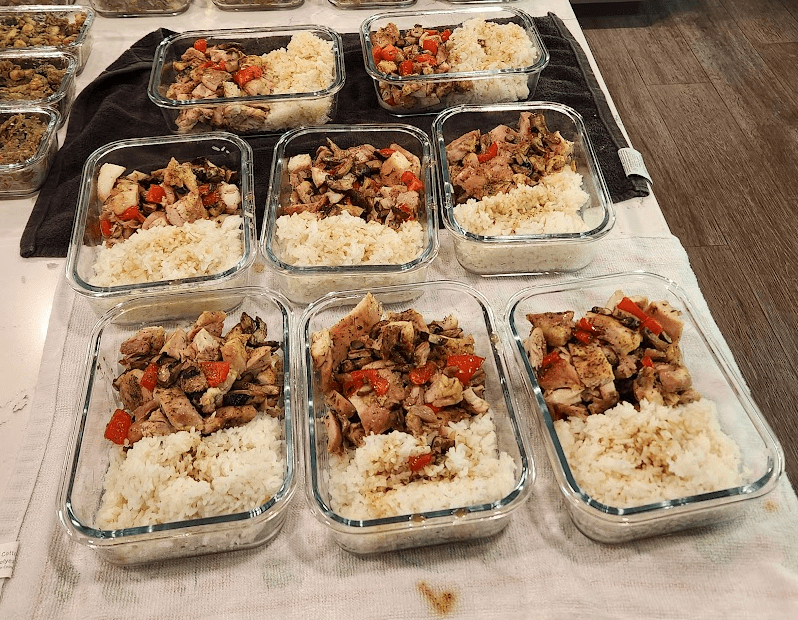
Run multiple appliances simultaneously to reduce time input. Cook chicken in the oven with veggies and carbs on the stove. Have a second burner going for your ground beef recipe. You can cook, portion, and wash dishes for 6 lunches and 6 dinners in less than 2 hours.
Macros, Calorie Tracking, and Meal Prep: How They Intertwine
Our approach to weight loss is built on calorie awareness and tracking. Meal prep complements this in a specific, measurable way: When your meals are prepped and portioned, you can pre-log your entire day in under 2 minutes.
As you are cooking breakfast, log it. Log your lunch and dinner too, they are already saved as a meal on your calorie tracking app from last week.
Here is the workflow that works for me:
- Design your meal before going to the grocery store
- Weigh your food as inputs for cooking
- Record each weight in a spreadsheet
- Record macros from the labels and scale based on amount
- Sum calories and macros
- Divide by 6 (or whatever number of meals you are making)
- Add the custom meal into your calorie tracking app so it is ready to add to each day
- Log each meal each day at breakfast
Logging your meals is quick and easy once you have the infrastructure in place. If you cook the same recipe week-to-week, you will not have to redo the spreadsheet unless you modify quantities.
You know your protein, carb, and fat intake for each day before it starts. This is essential if you are a powerlifter, runner, or athlete. The guessing is removed, and you know how much flexibility you have for snacks.
Each recipe below includes a macro breakdown for this reason, calculated on a per serving basis. Do the same for the meals you select, save them as a custom meal, and enjoy your time back.
The Recipes
Here are 3 foundational meal prep recipes, designed for a week’s worth of lunches or dinners. Macros are calculated per serving as portioned and may vary based on brand or fat content. Just to be safe, I would recalculate based on the labels of the food that you buy at the store.
These are recipes that my wife and I actually eat.
Recipe 1: Chicken and Quinoa
This is simple – chicken thighs on tray with veggies and quinoa. The quinoa is cooked with chicken broth and tastes delicious. It is my pick for a higher-protein starch.

Ingredients

Instructions for Chicken
- Preheat oven to 400°F
- Season chicken to taste and lay out on sheet pan
- Chop veggies and add to pan
- Lightly season veggies
- Place tray in oven at 400°F for around 15 minutes
- Flip chicken
- Place tray back in oven and cook for an additional 15 minutes
- Remove chicken, rest on stove-top for 15 minutes
- Chop chicken to bite-sized chunks
- Add chicken to meal prep container
Instructions for Quinoa (cook simultaneously)
- Start a pot of chicken broth to boil
- Add quinoa to the boiling broth
- Once broth returns to boil, put on low and cover
- Cook on low until broth is absorbed
- Add quinoa to meal prep container
Servings and Macros
- Servings: 6
- Prep time: 1 hour
- Calories/Serving: 616.8
- Protein/Serving: 71.5g
- Carbs/Serving: 44.3g
- Fat/Serving: 15.3g
Recipe 2: Ground Beef and Rice One-Pot
This is a quick recipe with big flavor and small clean-up. My parents have been cooking this for years and I can see why.

Ingredients

Instructions
- Put Dutch oven on low on stovetop with 1 tablespoon of butter
- Chop onion and add to Dutch oven
- Stir until caramelized, turn to medium-high and add beef
- Cook beef until browned
- Chop bell pepper and mushrooms
- Add rice, mixed veggies, and broth
- Heat to a boil, then turn to low and cover
- Cook until all broth is absorbed and let cool
- Portion into containers
Servings and Macros
- Servings: 6
- Prep time: 1 hour
- Calories/Serving: 635.9
- Protein/Serving: 55.4g
- Carbs/Serving: 57.1g
- Fat/Serving: 18.1g
Recipe 3: Venison Stir Fry with Fried Rice
This is a great way to use the deer meat in your freezer without sacrificing flavor. This is my wife’s favorite recipe that we cook for meal preps. We harvested 3 deer last season and this recipe took us into May. We love eating wild game whenever possible.
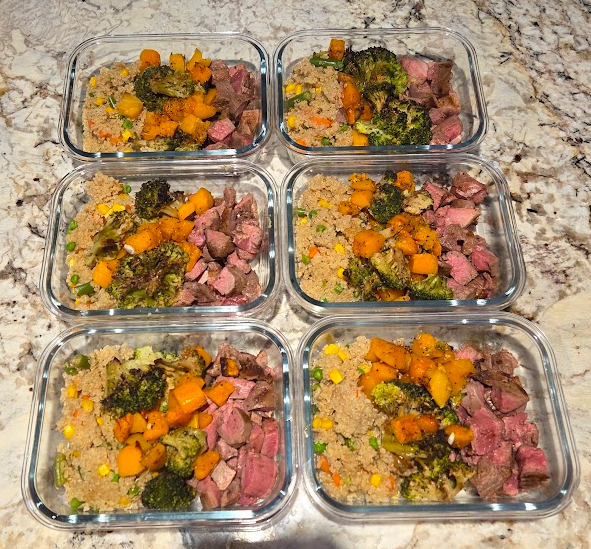
Ingredients

Instructions for Venison
- Select a moderately nice cut of venison (save the backstraps for steak night!) – eye round, bottom round, top round, or sirloin tip recommended
- Heat pan
- Butterfly cuts of meat if necessary and season
- Sear deer to desired temperature
- We recommend keeping it on the rare side as you will microwave your meal prep before eating
- Remove from pan, let rest for 15 minutes
- Cut into bite-sized chunks and add to containers
Instructions for Fried Rice (cook simultaneously)
- Bring pot of broth to boil
- Add rice and cook until broth is fully absorbed
- Remove from heat
- Move rice to side of pot and add eggs and scramble
- Add soy sauce and mixed veggies to rice
- Sautee in pan for 1-5 minutes
- Let cool and add to containers
Servings and Macros
- Servings: 6
- Prep time: 1 hour
- Calories/Serving: 662.7
- Protein/Serving: 65.9g
- Carbs/Serving: 59.3g
- Fat/Serving: 16.5g
Quick Start Meal Prep Formula
1 Protein + 1 Carb + 2 Vegetables + 6 Containers = A Week of Success
Your First Meal Prep Session: What to Do This Sunday
If you’ve never meal-prepped before, here is a minimal starting point that takes 60-90 minutes and covers either lunches or dinners for the work week:
Choose one protein: Chicken thighs (boneless/skinless for less work), salmon, ground turkey, steak, or eggs. Simple seasonings.
Choose one carb: White, brown, or basmati rice, quinoa, or sweet potato. Cook simultaneously.
Choose multiple easy vegetables: Broccoli, zucchini, bell pepper, green beans, corn, peas or more. Cook simply with measured oil.
Cook everything at the same time. This is supposed to add time back in your week, do it all at once. It will be second nature starting week 3.
Portion into multiple containers. Scale depending on whether your spouse wants to eat meal prep with you. Portions may be different so just weigh them if so. My wife tends to eat about half of a meal prep container per meal.
Wash dishes and you are done! No more decision-making, you now have meals ready to pop into the microwave to hit your protein and carb targets.
Frequently Asked Questions
How long do prepped meals last?
Most last 3-5 days or more. If you prep for a full week, consider freezing some meals for later in the week.
Is meal prep good for weight loss?
Yes, this is one of the most effective tools for weight loss as it eliminates guesswork. When meals are pre-portioned, you know how many calories and how much protein you are getting.
What foods are best for meal prep?
The best foods are whole foods and are simple, nutritious, and store and reheat well:
- Proteins: Chicken, turkey, beef, eggs, fish, venison/elk
- Carbs: Rice, quinoa, sweet potatoes
- Veggies: broccoli, zucchini, peppers, green beans, peas, corn
How many meals should I prep each week?
I would start with 5-12. You want enough to cover a full week of either lunches or dinners, for you and your spouse. As a beginner, shoot to cover all lunches and dinners during the workweek. You do not need to prep every meal, just reduce decision-making burden and make health automatic.
How much time does meal prep take?
A weekly session will usually take one to two hours depending on how many meals. You will save multiple hours by bulk prepping and using multiple appliances at once.
Do I need to count calories if I meal prep?
No, but calorie tracking makes meal prep more effective if your goal is weight loss or performance. Pre-logging meals will help you to understand your intake and make informed adjustments.
What containers are best for meal prep?
Glass containers are the best choice as they are durable, dishwasher safe, and microwave safe. Get a big pack with multiple containers of the same size for ease of measurement and stacking.

Can meal prep work for families?
Absolutely, just cook larger batches.
What if I get bored from repeating meals?
You can vary seasonings and vegetables while keeping the same core ingredients. Variety often comes from seasoning, sauces, and vegetables—not from reinventing every meal.
Is meal prep cheaper than eating out?
Yes, significantly cheaper. Buy ingredients in bulk and cook at home for healthier and cheaper meals.
Common Meal Prep Mistakes
- Prepping too much food too soon
- Choosing bland, boring meals
- Not varying vegetable selection
- Skipping logging calories
- Forgetting containers in the back of the fridge
- Expecting fish to last a week or longer
- Overcomplicating recipes
The Habit That Holds Everything Together
Every framework on Roam and Refine distills to the same core truth: the goal is not perfection each and every day. The goal is consistency, week after week, month after month, year after year. I want to help you unlock the compound effect so that you can achieve your life’s mission.
Meal prep is not exciting. You spend part of your Sunday afternoon cooking instead of chilling. Remember that this will help the scale move in the direction you want it to. The habit of meal prepping will keep your calorie tracking accurate. You will eat real food on Wednesday night, after 12 hours of meetings and grinding through analyses.
The people who succeed at sustainable weight loss are not the ones with the most discipline or best genetics – they are the ones who build robust systems into their lives. The framework presented in this article will help you unlock one of the most powerful systems available to you: meal prep.
Start this weekend. Remember, one protein, one carb, multiple veggies. Two minutes of logging. Feel free to cheat and just start with the recipes I gave you. They work for me.
This is the whole habit. Build it once and reap the rewards for years.
The information on this blog, Roam and Refine, is for educational and informational purposes only. It is not intended as medical advice. Always consult with a doctor or qualified health professional before beginning any new exercise or nutrition program. By using this site, you acknowledge that you are voluntarily participating in these activities and assume all risks of injury. Roam and Refine and its authors are not responsible for any liability, loss, or damage caused directly or indirectly from the use of this information.
Leave a Reply