


You don’t need another exhausting decluttering weekend. This simple donation box system keeps clutter from piling up with one box and three rules.
Most decluttering advice assumes you’re starting from zero: block off a Saturday, pull everything out of the closet, sort it into piles, feel exhausted by 2pm, and quit halfway through the garage. That works once. It doesn’t work as a system, because clutter isn’t a one-time event; it slowly happens. New stuff comes in every week. If you don’t have a matching system for stuff going out, you’re always going to lose that trade.
The fix isn’t a one-time spring cleaning or purge, it’s a habit. Specifically: one donation box, always staged, always open, with three rules that keep it moving instead of turning into another pile you’re avoiding.
Why the “big declutter” approach fails
A full-house cleaning and organizing fails for the same reason crash diets fail: it’s not sustainable, and it doesn’t change the underlying behavior. You spend a weekend hauling bags to Goodwill, feel great for a month, and then six months later you’re standing in the same closet wondering how it filled back up. It filled back up because nothing changed about how you handle stuff on a normal Tuesday. The purge cleaned up a symptom, but it didn’t fix the input.
A donation box habit fixes the input. It gives you a standing, low-friction place for “this doesn’t belong here anymore” to go the moment you notice it, not three months later when you finally work up the energy for another purge weekend.
The system: one box, three rules
Rule 1: Make the exit easy.
Make sure to put the box somewhere you already pass.
Don’t put it in the attic, the garage rafters, or anywhere that requires a special trip. Put it somewhere in your normal path, like a closet floor, bottom of a coat closet, corner of the laundry room. If getting to the box takes more effort than putting the item back where it was, you’ll put it back where it was every time.
Rule 2: Make the decision immediately.
If you’re lukewarm about owning it and don’t have a specific reason to keep it, it goes in the box.
This is the rule that actually does the work. The moment you catch yourself holding something and thinking I haven’t used this in a while or I don’t know why I still have this, that’s the signal, not a reason to set it back down and decide later. “Later” is where clutter comes from. You already made the call in that half-second of hesitation; the box just makes it official. If you try it on and it doesn’t work, if you pick it up to move it and think “why do I still have this,” or if you’re cleaning a shelf and there’s a maybe, it should go straight into the box.
The exception is anything seasonal, safety-related, or genuinely difficult to replace. A snow shovel you haven’t used in two years may still be earning its place in your garage. The goal is to remove unnecessary stuff, not to punish yourself for owning useful things.
If you think an item is worth selling, list it within seven days. If it hasn’t sold within 30 days, lower the price once or donate it. Otherwise, the “sell” pile becomes a permanent storage category.
Rule 3: Give the box a scheduled exit.
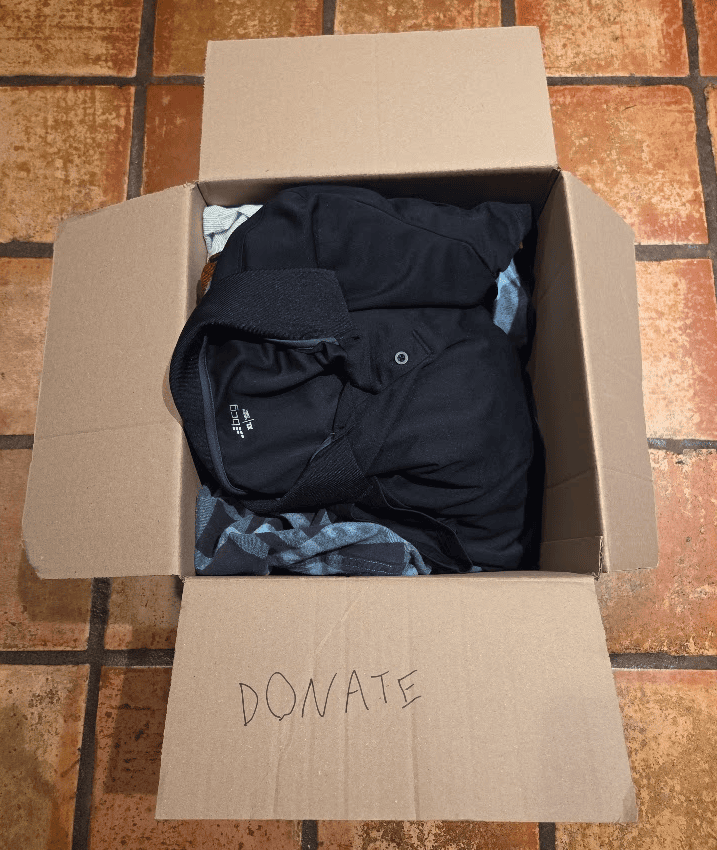
This is the part most people skip, and it’s the part that actually makes this a habit instead of a pile. If the box only empties “whenever it gets full,” you’ll let it get full, then it becomes an eyesore, then you start avoiding it, and now you’ve recreated the exact clutter problem in miniature. Instead, tie the drop-off to something that already happens on a recurring basis: a bill you pay monthly, a grocery run, or on Sunday after your grocery shopping. On our weekly schedule framework, Saturday day trips already have a rotation: add the donation drop-off to the route on a set week of the month, and it becomes something that happens automatically instead of something you have to remember to do.
Pick a cadence that matches your household’s actual pace of turnover:
- Small household, low turnover: empty quarterly
- Family with kids, higher turnover (outgrown clothes, toys): empty every month
- Anyone mid-move, mid-renovation, or mid-closet-overhaul: empty weekly until things settle
The frequency matters less than the fact that it is scheduled and recurring on your calendar.
The Donation Box Needs an Input Rule
A donation box helps remove clutter, but it works even better when paired with a simple rule for new purchases:
Before buying a replacement, decide what happens to the old version.
New jacket? The old jacket needs a decision.
New coffee maker? The old one needs an exit.
New pair of boots? Decide whether the old pair is actually earning its space.
You don’t need a strict “one in, one out” rule for every object in your home. But for categories that tend to accumulate (clothing, shoes, kitchen equipment, toys, and hobby gear), it is one of the simplest ways to keep the inflow and outflow of stuff balanced.
Where the Box Actually Earns its Keep
The moment I usually realize I have unused items is when I’m packing for a trip. I pull out a jacket I haven’t worn in two years, discover I own three versions of the same piece of gear, and suddenly the donation box has a job. Here’s where it makes sense to add to the box:
- Laundry day. You’re already handling every piece of clothing you own. If something doesn’t go back in the drawer without a second thought, it goes in the box instead.
- Seasonal swap. Pulling out cold-weather gear or packing away summer clothes is the single highest-yield moment for a donation pass — you’re handling everything anyway.
- Pre-trip packing. If you’re the type who plans road trips and park visits ahead of time (hopefully using our guide to finding parks!), packing is a natural checkpoint. Laying out gear before a trip surfaces the stuff you forgot you owned, and the stuff you own two of because you couldn’t find the first one.
- Post-trip unpacking. The reverse works too. Unpacking is when you notice what you didn’t use and remember why, what you overpacked, and what’s been dead weight in a bag for three trips running.
- Gift season, both directions. Before new things come in, make room. After they come in, the old version of that item (the coffee maker, the jacket, the pair of boots) has a clear exit instead of sitting in a closet as backup gear you’ll never use.
What Goes In and What Doesn’t

Not everything belongs in the donation box, and treating it as a catch-all is how it turns into clutter itself.
Belongs in the box:
- Clothing that fits and is in decent shape, but you haven’t worn in a year
- Duplicate gear, like the second can opener, the backup phone charger you don’t need
- Anything you kept “just in case” more than two seasons ago
- Books, kitchenware, and small home goods in usable condition
Doesn’t belong in the box:
- Anything worn out past the point of use: that’s trash, not donation
- Sentimental items you’re on the fence about. Don’t force a sentimental decision under the one-touch rule; give those their own separate, much smaller box with its own occasional review, so they don’t stall the main system
- Anything that needs repair you actually intend to do. If you haven’t touched it in six months, be honest with yourself about whether “I’ll fix it” is true or just easier to say than “I don’t need this”
That last one is the most common way this system quietly breaks. Be honest about it the same way you’d want an honest trail report before a hike. An item that’s “almost fixed” for a year isn’t a project, it’s clutter with a better excuse.
Donate Things Someone Else Can Actually Use
The donation box should not be treated like a trash can.
Before donating something, ask whether you would feel comfortable giving it directly to someone who needed it. Clothing should be clean and wearable. Kitchenware should be usable. Electronics should work or be clearly labeled as needing repair if the receiving organization accepts them.
If something is stained, broken, unsafe, or unusable, it probably belongs in the appropriate trash or recycling stream instead.
The goal is not simply to move your unwanted junk from your house to someone else’s warehouse. Donate useful things that can genuinely have another life.
Create an Exit System, Not Just a Donation Box
The donation box is the default exit for small, usable items, but not everything leaving your house belongs in the same place.
A simple four-lane system works better:
Donate: Usable items that aren’t worth the time and effort required to sell.
Sell: Higher-value items that are worth listing, but give yourself a deadline. If it hasn’t sold within 30 days, donate it. This 30-day rule has helped us keep clutter out of the garage too.
Recycle or dispose: Broken, worn-out, or otherwise unusable items that should not be passed on to someone else.
Give away: Items a friend, family member, or neighbor specifically needs.
The key is to avoid creating four new piles of clutter in place of one old pile. Each category needs an exit path and a deadline.
For most households, the donation box should remain the default because it has the lowest friction. Selling an item takes photos, a listing, messages, and coordination. Donating it takes putting it in the box and taking it with you on your next scheduled drop-off. That said, if you regularly have higher-value items to sell, create a separate selling workflow. The key is to keep those items moving instead of letting them become a permanent “I’ll list this eventually” pile.
The goal isn’t to maximize the money you recover from every unwanted item. The goal is to keep your home from becoming a warehouse.
Where Should You Keep Your Donation Box?
The best location is somewhere visible enough that you remember it exists but unobtrusive enough that it doesn’t become part of the clutter.
Good locations include:
- The bottom of a coat closet
- A laundry room
- A mudroom
- A bedroom closet
- A garage entry area
- A utility room
Avoid putting it:
- In the attic
- Behind other storage
- In a difficult-to-access garage corner
- Somewhere you only visit during seasonal cleaning
For families, a larger open-top laundry basket or plastic tote may work better than a cardboard box. For apartments, a collapsible bag or small bin may be the better solution.
The best donation container is the one you will actually use.
Troubleshooting the Habit
Here are some common implementation issues:
The box fills up and just sits there. You skipped rule 3. Attach the drop-off to something already on your calendar instead of waiting for motivation.
You keep taking things back out of the box. That’s usually a sign the one-touch rule isn’t being followed in the moment, and items are going in during a “later” pass instead of the moment of hesitation. Go back to catching the “maybe” the first time.
One box isn’t enough for a family. If others in your family are finding themselves under a pile of clutter, help them out by providing their own bin, even a small one, and let each person run their own version of the rules. Kids especially do better with a bin that’s clearly theirs to fill.
You don’t know where to actually drop things off. Pick one donation center near your regular errand route and default to it. Don’t spend decision energy on where to go every single time. Consistency beats optimization here.
Frequently Asked Questions
How do I start a donation box habit if my house is already cluttered?
Don’t wait until your entire house is organized. Put the donation box in place today and start using it during normal activities.
If you already have significant clutter, you may need one initial decluttering session to create a baseline. But don’t try to perfect the entire house before starting the habit. The donation box is what keeps the clutter from rebuilding afterward.
This is important because your article correctly argues that the system is not a replacement for every major decluttering project.
How often should I empty a donation box?
Most households should empty their donation box at least monthly. Smaller households with less turnover may only need to do it quarterly, while families with children or people actively decluttering may need a weekly schedule.
What should I do with items that are worth selling?
Set a deadline. List the item promptly and give yourself 30 days to sell it. If it doesn’t sell, either lower the price once or donate it. A “sell later” pile should not become permanent storage.
Can I have more than one donation box?
Yes, but keep the system simple. A family may benefit from a small donation bin in each bedroom or a separate one for clothing, while a small apartment may only need one collapsible bag.
The important thing is that each container has a clear purpose and a regular exit date. Multiple bins should reduce friction, not create more places for unwanted items to accumulate.
What can I use instead of a donation box?
Any container that is easy to access can work, including a laundry basket, plastic tote, reusable donation bag, or collapsible bin. The container matters less than having a dedicated place for unwanted but usable items.
Should I use a one-in-one-out rule?
A one-in-one-out rule works best for categories that tend to accumulate, such as clothing, shoes, kitchen appliances, and hobby equipment. It does not need to apply to every item in your home.
How do I stop my donation box from becoming clutter?
Schedule regular drop-offs and treat the box as a temporary staging area rather than permanent storage. If it consistently fills faster than you can empty it, increase the frequency of your donation trips.
Should I donate something I haven’t used in a year?
Not automatically. Consider whether the item is seasonal, safety-related, difficult to replace, or genuinely useful for a specific situation. If you have no clear reason to keep it and are only keeping it out of habit, it is a good candidate for the donation box.
The bigger picture
This is the same principle behind most of the systems on this site — the closet organization setup, the game freezer rotation — none of them are about one big effort. They’re about designing the small, boring, repeatable habit so the big effort never has to happen again. A donation box that empties itself into your existing routine does more for a clutter-free house than four purge weekends a year ever will, because it works with how you actually live instead of against it.
Start with one box, three rules, and a date on the calendar. That’s the whole system.
Leave a Reply