
Now that you have run 3.1 or 6.2 miles, why not 13.1? This mid-length race is a natural stepping stone and will push your limits as a runner.
Training for a half marathon (13.1 miles) will teach you fueling, pacing, recovery, and safely adding volume to build your aerobic base. It can even help you live longer.
5K to Half Marathon Progression
Your first running goal was naturally to run a 5K. Once you hit that finish line, exhausted and out of breath, the real work begins. If you have not yet run a 5k, check out How to Start Running.
If you can run 5K, you can run 10K within 2 months with minimal strain. After you finish the Bridge to 10k program, taking you from running a 5K twice a week to running a 10K twice a week, it is time to start adding days.
While in the Couch to 5K and Bridge to 10K, you ran 3 days per week. This works for beginners trying to run short distances, but you will need to step it up to safely accomplish your goal of running a half marathon.
I recommend a structured program, so that an expert can guide you in safely adding volume.
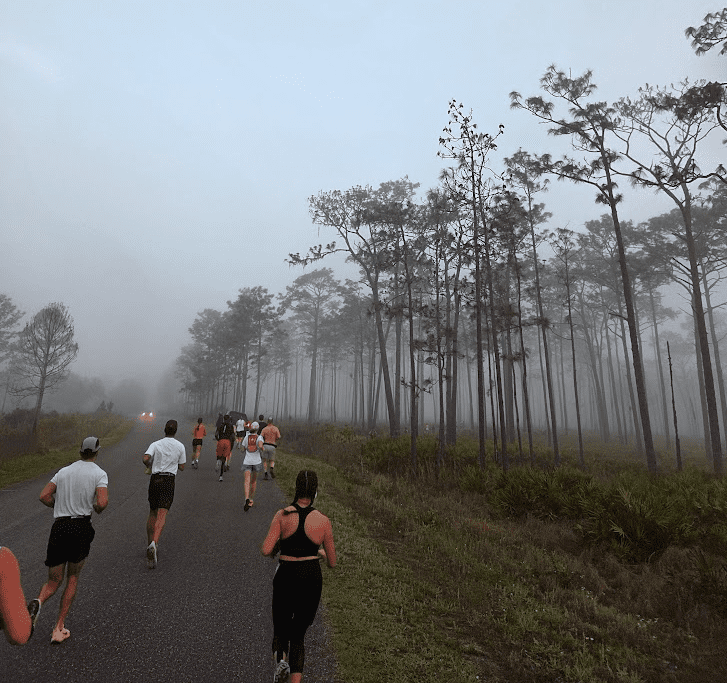
Recommended Strategy
Increasing distance from 10K to a half marathon is simple, but not easy. It will take determination and stretch your limits as a runner.
You should follow the 80/20 method:
- 80% of running is completed at an easy effort
- 20% of running is completed at a moderate to hard effort
As somebody who recently ran your first 5K, you might have NEVER run at an easy pace. This will take practice, discipline, and training.

Once you start running at an easy pace, add days of running until you are running short distances 6 days a week. Start to stretch one run a week into a long run, completed at an easy pace. Do one tempo and one interval run a week (these are the 20% moderate to hard).
Lifting Weights
I think that most running plans skip the importance of lifting weights. Personally, I hit the gym 4 days a week on top of my running plan, and you should too. If this sounds impossible, check out my post on incorporating fitness into your busy weekly schedule.
While not technically required for you to run your first half marathon, lifting weights will make you more robust. It will reduce your injury risk and make you more confident on the trails.

I would recommend hitting legs at least 2 times per week to improve running economy, increase power, reduce injury risk, and build endurance.
Fueling Strategy
While a 10K is achievable without water or nutrition, you are going to need to start supplementing while working up to the half marathon distance. I recommend bringing along water, electrolytes, and carbs starting on your 8-mile long runs, but you may need them sooner in particularly hot climates.
I bring the following with me on long runs:
- Carbs – Honey Stinger Gels and GU
- I try to eat 40 grams of carbs per hour for a pick me up
- Water in bottles
- For runs around 10 miles, I am able to stay alive by bringing 2 250ml bottles. This is not enough but it keeps me from dying and helps to get the food down. I am experimenting with bringing a camelback backpack as well
- Electrolytes – Salt Sticks
- I follow the recommended dose for salt sticks and find it really helps with recovery and keeping me from getting headaches from the heat
80/20 Running Half Marathon Level 1 Overview
There are many plans available to get you over the finish line of your first half marathon. I heard good things about the 80/20 Running book by Matt Fitzgerald, so I purchased it. If you want a shorter plan, the Hal Higdon Novice 1 might be a good fit.
The book quickly got to the point on the science behind the recommendations and running plans in the first half, then recommended workouts and running plans in the second half. I found that by using sticky notes, I could mark pages to help decode the workouts.
For example, the very first workout for the Half Marathon Level 1 plan is the Fast Finish Run 1. I have a sticky note marking the page for this run, so I can quickly flip back and decode it as a 25 minute effort comprised of 5 minutes zone 1, 15 minutes zone 2, and 5 minutes zone 3.
The half marathon plan one starts with a 9-week base phase, then a 7-week peak phase, and finally a 2-week taper phase. Every 3rd week is a deload week, cutting back slightly on volume.
Each week is structured similarly:
- Monday: rest day
- Tuesday: moderate intensity run (either fast finish or tempo)
- Wednesday: low intensity run (foundation or recovery)
- Thursday: low intensity run (foundation)
- Friday: high intensity run (intervals)
- Saturday: low intensity run (recovery)
- Sunday: low intensity run (long run)
The runs split intensity on time spent running using the 80/20 method and gradually build volume throughout the training plan. For the last two weeks, volume is reduced to get you fresh for your race.

80/20 Running Half Marathon Level 1 Review
I began the 80/20 Half Marathon Level 1 plan in December 2025. Prior to starting, I had completed the Bridge to 10K near the beginning of 2025 and had been running very little during most of the year.
My weekly mileage prior to starting this program was roughly 10 miles per week. I would recommend working up to 15-20 miles per week (i.e. Bridge to 10K completion) and it will go smoother.
I shifted the days running around to suit my schedule better. Since I do not work on Fridays but my wife does, so Friday is the ideal day for me to run a long run. I also like to take day trips on Saturday, so it made the most sense as a rest day. Subsequently, I ran the 6 days from Sunday to Friday, running in the mornings before church and work.
I found the first few weeks to be easy running-wise, but the adjustment to running in the morning was not. I eventually built the discipline to just get up and go, but it was not easy. By the end of this program, I was looking forward to my morning run, especially as my fitness improved.
Most of the runs were fun, but I was not a fan of the fast finish runs. While I believe the purpose of the fast finish runs is to get you to build toughness and the ability to push at the end of the run when you are fatigued, I did not like them. I did not like returning home with my heart rate high and trying to cool down for work, so I walked around to cool down at the end of them.
Long Runs
To run a half marathon, you are going to have to run long runs. I actually enjoy these the most after this plan.
The increased volume from doing this program made my long runs surprisingly easy. Running in zone 2 made them a low-threat activity. The hard run is the interval run, so it was nice to run slowly using my new-found fitness gains every week.
I was scared for my 8 mile run, but it went smooth. The run that hurt the most occurred in week 5: the 9-mile long run 4. The run itself was fine, but I guess my form wasn’t. When I got home I sat down too quickly and my lower back totally locked up. I had to spend the rest of the day in bed. This problem was resolved in future long runs by focusing on my form and doing extended cool-downs: walking around, stretching my back, and cleaning the house before sitting down.
I was the most happy when I did my second 10-mile run: it felt easy. I knew that this plan was working, the volume was doing its thing, and I was going to be able to run the half marathon.
Successes and Failures
On weeks where I was out of town, I did my best to keep up with the plan using hotel treadmills. I did not always find the time and I did have to repeat a week. The other time I had to repeat a week was when I had the flu and strep, I did a minimum viable workout instead.

I was VERY consistent on the runs when I was in town. Starting my day with a run meant that I could not start my workday until my run was complete. This was a reasonable motivator to get moving.
I learned fueling on the long runs, and the 10 mile runs taught me pacing and fueling prior to the race.
The Incident
I started trail running on my long runs during the longest run of the training plan: a 12-mile effort with fast finish. I realized that running a long run on the pavement is kind of boring, and there are a lot of cars. It is also pretty high impact on your joints. I live close to some wilderness areas, so I elected to do my long runs on trails.

This trail run was smooth enough, but I almost tripped on roots a few times. When I got to mile 11, it was time for the fast finish. I started hauling butt. Remember, this was my longest run ever, and I now had to run a mile quickly. When I made it to around the 11.4 mile mark, suddenly I was on the ground.
My foot had snagged a root, causing me to fall. This was no normal fall, since I was traveling at an all-out mile pace. I slammed into the ground with my chest primarily, but also my knees. The force knocked the wind out of me, and I genuinely did not know if I was going to need to use my Garmin inReach.
After 2 minutes, I caught most of my breath and realized that I had not broken any bones, so I stood up. I knocked some of the dirt off, but it stuck to my soaked clothes. I was bleeding, but not super badly. After standing up, I started back to the parking lot, picking up to a slow jog.
My very first trail run, the longest run of the training plan taught me two key lessons:
- Do not try to run super fast on trails
- Pick up your feet!
With those lessons out of the way, I realized that I would be able to run the half marathon. If I can run 12 miles, I can run 13.1 miles.
My left knee was slightly injured, but it seemed to mostly heal in the 3 weeks leading up to the race. I never went to the doctor, as I really wanted to complete this goal. Maybe not the smartest approach.
Race Day
The taper was nice, and I found myself feeling energized leading up to the race. Having built up to 30 miles a week, the reduced volume had me chipper leading up to the race.
I ran a small half marathon at state park around 2 hours from my house, but it was very well organized. They mentioned that nutrition and electrolytes were available at aid stations, so I only brought one GU pack. I did bring my normal salt sticks though just in case.
My goal pace was sub-2 hours. I think I got this idea because my tempo runs were at around an 8:45-9:30 pace, but these only worked up to 30 minutes in zone 3 during the training. I took off like a rocket, ready to go sub-2.
After the first 5K, I started to slow down slightly. This was not by choice, it is just what my body did. By mile 5, my heart rate started to climb into zone 5 territory, and I slowed down to keep it in zone 3-4. By the end of mile 5, I was running 10-minute miles.
I figured that I would take a mile or so at my new slower pace before ramping back up to the 9-minute miles. This did not happen. Around mile 5, I asked the aid station for food, and they gave me a granola bar. Not really what I had in mind for running nutrition. This was challenging to eat on the move, and did not even have that many carbs in it.

Realizing I would now be running my first half marathon on a granola bar and a GU pack, I started to get scared. I slowed down more and more, and by mile 8 I was at 11 minute miles, I knew there was no shot at going sub-2 hour. I realized here that I should just try to finish for my first half.
Mile 12 was the hardest for me, and I slowed down even to a walk for around a quarter mile. Having no carbs in my system, I was cold and hit the wall. When I saw the finish line, I got a second win and sped up for the last half mile.
Reflections and Lessons Learned
When I hit the finish line, I was spent. I walked around, drinking water and eating food for 45 minutes before I ventured to sit down. Every part of my body hurt: feet, legs, abs, back, even my right shoulder.
This was a humbling event, I began by passing people for the first 5 miles and ended by getting passed by young men and women, old men, old ladies, and even little girls in tutus.
While the half marathon is physically and mentally challenging, doing it without enough carbs made it downright religious.

I learned that I am capable of pushing through and doing hard things. I also learned that maybe I shouldn’t have tried to go at a fast pace, burning through all of my carbs in the first 5 miles.
My time was 2:24:21. My next goal for the half marathon is still sub-2 hour, but it might take me a few races to get there.
Recovery
I did not try to drive home for around an hour after the race ended. I stretched out, hydrated, and ate for a while, which seemed to do the trick. The rest of the day was spent on the couch on the couch.
The following day, I went hunting, and was pretty sore. It was not super bad, but every part of my body was still sore.
On Monday, I went for a 10-minute recovery jog. This sucked.
On Tuesday, I went for a 20-minute recovery jog. This sucked but not as much as Monday. A coworker mentioned that I looked a little beat up. He was right.
On Wednesday, I went for a 30-minute recovery jog. This was starting to feel normal. My energy levels have still not normalized throughout the day.
On Thursday, my plan is another 30-40 minute recovery jog. On Friday, my plan is to do 4-6 miles at an easy pace, as long as the Thursday run is fine.
Next week, I will begin training for the next event!
What’s Next
Now that you can run a half marathon, there are a few paths to take:
- Train for a faster half by adding volume using a more advanced plan
- I would recommend 80/20 Half Marathon Level 2
- Train for your first whole marathon
- I would recommend 80/20 Marathon Level 1
- Train for a mid-length race (such as a 30K trail run)
- I would recommend 80/20 Marathon Level 1, doing the long runs on trails
As for me, I am following the 80/20 Marathon Level 1, targeting a 30K trail run in around 13 weeks. Living in the heat of central Florida, this 18+ mile run is a night run, starting at 7pm. I will be doing my training long runs on local trails.

Summary
Transitioning from a 5K or 10K to half marathon distance is challenging, but it is an achievable goal. I recommend doing the 80/20 Running Half Marathon Level 1 plan, as it worked for me to get me over the finish line.
If you are new to running, make sure to follow our guide to start from scratch.
The information on this blog, Roam and Refine, is for educational and informational purposes only. It is not intended as medical advice. Always consult with a doctor or qualified health professional before beginning any new exercise or nutrition program. By using this site, you acknowledge that you are voluntarily participating in these activities and assume all risks of injury. Roam and Refine and its authors are not responsible for any liability, loss, or damage caused directly or indirectly from the use of this information.
Leave a Reply