

If you own a home in Florida or anywhere across the South, you already know that the lawn never really quits. While your friends and cousins park their mowers in October and forget about them until April, you’re out there in December, still mowing. This year-round growing season changes the math on one of life’s great mysteries: should you mow or pay somebody else to?
Quick Answer: For a typical quarter-acre Florida lot, DIY mowing costs about $426 per year plus your time. Hiring a lawn service costs roughly $2,250 annually. If your time is worth more than about $32/hour, hiring a lawn service is usually the better financial choice. This all depends on your time, lot size, and what you value.
I’ve owned and maintained lawns in Florida for years and have used both DIY and professional lawn services. The calculations below are based on current Florida lawn service pricing, equipment ownership costs, and typical mowing frequencies for warm-season grasses.
Let’s get into the math.
The Florida Lawn Reality
Unlike other states where lawns go dormant for up to half the year, most Florida grass varieties like St. Augustine, Bermuda, Bahia, and Zoysia can grow year-round. In Central Florida, you’re typically mowing weekly during the summer and every 10-14 days during the cooler months. For simplicity, we’ll assume a baseline of 45 mows per year. This number will be higher if you are in an HOA.
How Much Does Lawn Service Cost in Florida?
Professional lawn service pricing in Florida varies by market, but it is high and on the rise. For a quarter-acre residential lot in 2026:
| Location | Cost Per Visit | Annual Cost |
| Orlando | $38-$52 | $1,710-$2,340 |
| Jacksonville | $36-$47 | $1,620-$2,115 |
| Miami | $50-$90 | $2,250-$4,050 |
| Florida Average | $50 | $2,250 |
At $50/visit and 45 visits per year, you are looking at an annual cost of $2,250 per year for lawn service for a typical Florida homeowner on a standard residential lot. In smaller markets or more rural areas with cheaper service, your annual costs might be lower, $1,600-2,000 per year. In Miami and South Florida, you would be pushing $3,000 annually, especially after accounting for the shorter winter.
These prices typically include mowing, string trimming (weedwhacking), edging along sidewalks and driveways, and blowing clippings off of the paved surfaces. The time comparison needs to account for all of these tasks, not just pushing a mower.
The Cost of Doing It Yourself
The cost of doing it yourself is not just gas and purchase costs. You need to account for the upfront cost of equipment, as well as depreciation, fuel, annual maintenance, storage, and your time, the highest cost.
Equipment Purchase Cost
Your equipment purchase cost is dependent on lot size. For a quarter-acre or smaller, you likely want a self-propelled walk-behind mower. For a larger lot, you’ll want to consider a riding mower or zero-turn.
To purchase new equipment:
- Basic Push Mower: $260-320
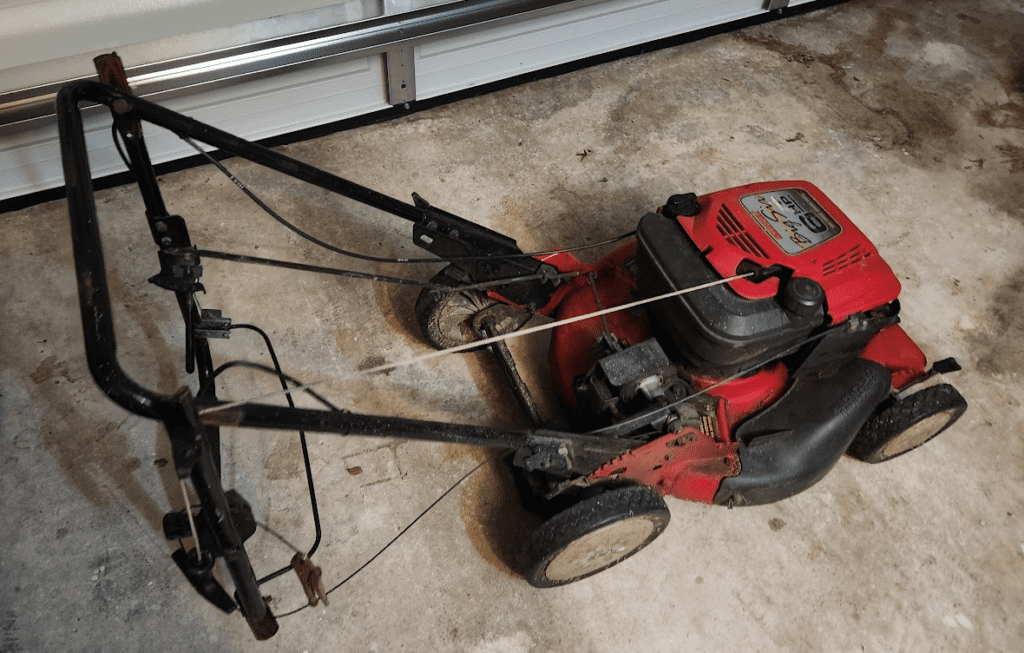
- Self-propelled gas walk-behind (the workhorse for most Florida lots): $400-700
- Battery-powered self-propelled: $550-900
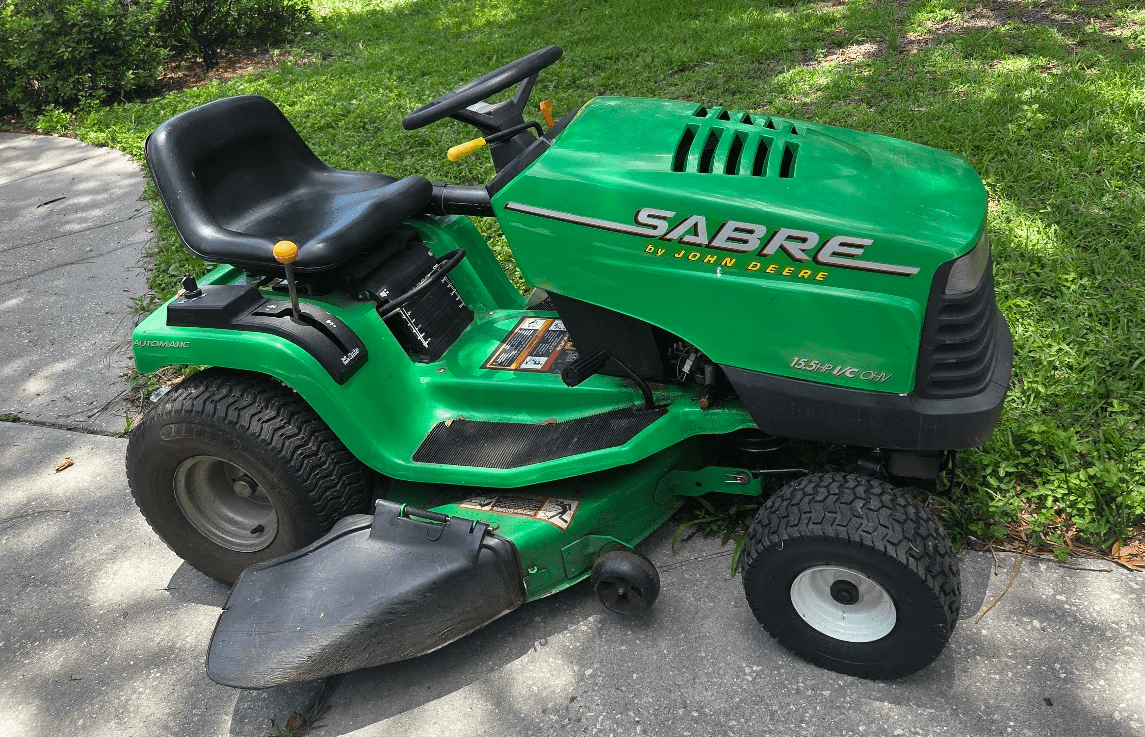
- Riding mower: $1,800-3,500
- Zero-turn mower: $3,000-5,000
Used equipment:
Marketplace is your friend here. A used self-propelled mower in decent shape will typically run you $100-300. Used riding mowers in good shape can be had for $500-1500, though buying used equipment that you can’t test is a gamble. Budget for repairs if buying used.
You’ll also need:
- String trimmer (weed eater): $100-300 new, $50-150 used
- Leaf blower: $150-300 new, $100-200 used
- PPE: safety glasses, ear protection, gloves: $25-40
A realistic starter kit for a quarter-acre lot in Florida:
New: $700-1300 (mower + trimmer + blower)
Used: $300-700
Depreciation
Equipment does not last forever. A well-maintained gas mower lasts 8-10 years with regular use. We can assume 8 years for a Florida home, since you will be mowing a lot more than in other states.
- Mower: $700 / 8 years = $87.50/year in mower depreciation
- Trimmer: $300 / 8 years = $37.50/year
- Blower: $250 / 8 years = $31.25/year
- Total: $162.25/year in depreciation
Fuel
A typical gas self-propelled walk-behind uses around 0.35 gallons of gasoline per mowing session. Call it 0.5 gallons including consumption for weed eating, edging, and leaf blowing. With gas around $3.50/gallon and 45 mows per year, you are consuming $78.75 in fuel costs.
Annual Maintenance
The heat and humidity in the southern US are hard on equipment. Grass in the summer is dense and wet. You should budget for:
- Annual tune-up (oil change, spark plug, air filter): $25-50 DIY, $60-100 at a shop
- Blade Sharpening (twice per year for an even cut): $10-30 professionally, or $0 if you have an angle grinder
- Repairs (belts, wheels, cables, carb cleaning): $50-100/year across the equipment life
Realistically, annual maintenance will total $100-175/year between all of your equipment, or roughly $135/year on average.
Storage
Most people forget this entirely. A mower, trimmer, blower, and edger attachment need a home. If your garage has room, the cost is effectively zero. If you’re buying a shed or sacrificing space you would otherwise monetize (for side gigs, flipping, etc), that’s real money.
A decent outdoor storage shed might cost $400-1,200 and last around 15 years. Remember, hurricanes decrease the lifespan of sheds. This comes out to $30-80 per year, so we’ll assume storage costs are $50 per year for homeowners who need to dedicate space.
Total DIY Annual Cost
For a typical Florida homeowner mowing a quarter-acre lot with a new self-propelled walk-behind:
| Category | Annual Cost |
| Equipment Depreciation | $ 162.25 |
| Fuel | $ 78.75 |
| Annual Maintenance | $ 135.00 |
| Storage | $ 50.00 |
| Total | $ 426.00 |
Your out-of-pocket equipment cost would be $426/year, without accounting for y
our time.
Is It Cheaper to Mow Your Own Lawn or Hire a Lawn Service?
Adding in your time is where the decision actually gets made.
How long does it take to mow a quarter-acre lot? With a self-propelled mower, figure 35-45 minutes for mowing, plus 15-20 minutes for trimming, edging, and blowing off. Total direct time would be an hour, plus the indirect time of putting your shoes on, setup and stowing/maintaining the equipment and post-mowing clean-up. Let’s assume a total process time of 75 minutes (1 hour 15 minutes).
At 45 sessions/year, you are spending 56.25 hours per year on lawn maintenance if you do it yourself. This is over a full workweek!
So, what is your time worth?
To find your break-even hourly rate, calculate:
(Annual service cost – Annual equipment cost) / Annual hours spent mowing
Using our Florida averages:
($2,250-426)/56.25 hours = $32.43/hour
That’s your break-even threshold. If your time is worth more than around $32/hour to you – whether as earned income, recovery time, or time spent with family – hiring a lawn service is the economically rational choice.
If your time is worth less than $32/hour to you, or you genuinely enjoy mowing, doing it yourself makes financial sense.
The more money you can make, say $100/hour, the more sense it makes to work for an extra 20 minutes and pay a lawn service the difference than it does to spend an hour and 15 minutes doing it yourself.
How to Calculate This for Your Specific Situation
This formula works for any market. If you don’t like the numbers I used, here’s how to plug in your own numbers:
- Get three local quotes. Call or message three lawn services in your zip code.
- Price out your equipment. Get up to date numbers for equipment suitable to your lot size.
- Estimate your annual hours. Time yourself doing the full job, and multiply by your expected mow count. If you are in a colder climate, this will be a lower number.
- Solve the formula. (Annual service cost − Annual depreciation − $175 for fuel/maintenance/storage) ÷ Annual hours = Your break-even rate
- Compare that rate to how you value your time. Not just your wage, but your freedom to relax with your family or pursue a side gig.
Lawn Service vs DIY Cost by Lot Size
For larger lots, a half-acre or more, the math changes. Lawn services charge significantly more, but a riding mower lets you cover ground much faster. A zero-turn may be able to mow an acre in under 40 minutes. The higher equipment cost spreads over more service cost savings. If you have a large lot, it might be a lot cheaper to mow yourself.
Here’s a quick breakdown:
| Lot Size | Service Cost | DIY Cost | Hours/Year | Break-Even Rate |
| 1/8 Acre | $1,575 | $350 | 30 | $40.83/hr |
| 1/4 Acre | $2,250 | $426 | 56.25 | $32.43/hr |
| 1/2 Acre | $3,600 | $700 | 67.5 | $42.96/hr |
| 1 Acre | $6,750 | $1,000 | 56 | $102.68/hr |
1/8-Acre Lot
A small suburban lot can often be mowed in 20-25 minutes, with another 10-15 minutes spent trimming and cleanup. Total time commitment is roughly 40 minutes per mowing session.
Professional lawn service on a property this size might cost around $35 per visit, or approximately $1,575 per year.
Because the lawn is small, your fuel consumption is lower and equipment experiences less wear. Annual DIY costs might be closer to $350 per year.
At 45 mowing sessions annually, you would spend about 30 hours per year maintaining the lawn yourself.
Break-even hourly value:
($1,575 − $350) ÷ 30 hours = $40.83/hour
Half-Acre Lot
A half-acre property is where DIY mowing starts becoming more attractive. Most homeowners will either use a riding mower or spend considerably more time behind a self-propelled mower.

With a riding mower, mowing may take 45-60 minutes, plus another 20-30 minutes for trimming, edging, and blowing. Total time is roughly 90 minutes per mowing session.
Professional lawn service pricing commonly ranges from $70-90 per visit. Using $80 per visit, annual service costs would total approximately $3,600 per year.
Annual DIY costs increase because of the larger mower and additional fuel consumption. Assuming a riding mower, expect annual ownership costs of roughly $700 per year including depreciation, maintenance, fuel, and storage.
At 45 mowing sessions per year, you would spend approximately 67.5 hours annually maintaining the property.
Break-even hourly value:
($3,600 − $700) ÷ 67.5 hours = $42.96/hour
For many homeowners, a half-acre lot is the sweet spot where owning equipment begins to provide substantial savings.
One-Acre Lot
An acre of lawn is a completely different situation. At this size, most homeowners benefit from a zero-turn mower or commercial-grade riding mower.
A zero-turn can mow an acre in roughly 35-45 minutes under ideal conditions. Including trimming, edging, equipment setup, and cleanup, the total process may still take about 75 minutes per mowing session.
Professional lawn service for an acre commonly costs $120-180 per visit depending on location and complexity. Using a conservative $150 per visit, annual service costs reach approximately $6,750.
DIY costs increase because of the larger equipment investment, but they do not increase nearly as fast as service pricing. A homeowner operating a $4,000 zero-turn mower might spend roughly $1,000 per year on depreciation, fuel, maintenance, and storage.
At 45 mowing sessions annually, total time commitment is approximately 56 hours per year.
Break-even hourly value:
($6,750 − $1,000) ÷ 56 hours = $102.68/hour
At one acre, mowing yourself becomes extremely attractive financially. Unless your time is worth well over $100 per hour, owning equipment and doing the work yourself will usually save thousands of dollars per year.
The Bigger the Lot, the Better DIY Looks
For very small lots, hiring a lawn service can often make sense because the annual savings from DIY mowing are relatively modest. As lot size increases, however, professional lawn care costs rise much faster than equipment ownership costs.
In general, homeowners with quarter-acre lots tend to have break-even rates around $30-35 per hour. By the time you reach a one-acre property, the break-even rate can exceed $100 per hour, making DIY mowing the clear financial winner for many households.
Why You Might Want to Mow Your Own Lawn Anyway
Even if the math says to hire the work out, there are legitimate reasons why high-income people still push their own mower.
- It’s real exercise. Mowing your lawn might burn 250-350 calories. This additional volume can help reach cardio goals.
- It’s satisfying. If your work is theoretical, you will appreciate doing something with your own hands and seeing the result in the same day.
- It gives you ownership of your property. You will notice things like broken sprinkler heads and insect problems that a service crew racing through might miss.
- Quality control is better. Not all lawn services are equal, and lower-priced ones may cut corners.
- It’s meditative. This physical, screen-free work has a psychological value.
- It maintains your skills. Owning and operating equipment keeps you fresh on small engine maintenance and troubleshooting skills.
Strategies to Reduce the Cost or Time of Lawncare
If you can reduce the growth rate of your lawn, you can reduce the frequency of mowing, and also your fossil fuel, fertilizer, and water consumption.
- Plant a garden. The garden does not have to be mowed. Native plants use less water and feed the bees.
- Water your lawn less. If you can keep the grass alive with less watering, do it. The aquifer will thank you.
- Fertilize your lawn less. This will slow the growth of your lawn and will help save water and reduce nutrient runoff into Florida’s springs
- Buy used equipment. You can save money while keeping usable equipment out of landfills.
- Eliminate your need for mowing by planting no-mow ground covers, like clover or slow-growing grass alternatives.
- Mow less frequently to maintain allow more food for pollinators.
The Bottom Line
For a typical Florida homeowner on a quarter-acre lot paying market rates, the breakeven hourly value of time is roughly $30-35/hour. If your time is worth more than that, and you have overtime opportunities or a side gig, working and then hiring a reliable lawn service is the most rational economic decision.
Small lots favor hiring, and large lots favor DIY. Whatever you decide, run your own numbers first, as your market, lot and time are unique to you.
The content on Roam and Refine is for informational and educational purposes only and does not constitute financial, investment, or legal advice. I am not a registered financial advisor. Please consult with a certified professional before making any financial decisions.
Leave a Reply