
Congaree National Park is a national park experience that feels like the opposite of Yellowstone and Yosemite. We visited this floodplain in August of 2025 during the peak of the heat and mosquito season and had a great time.
This complete guide will share everything you need to know to make the most of one day in this South Carolina gem, including our takes on what worked, what didn’t, and why our favorite part of the experience was our Cedar Creek kayak tour with Carolina Outdoor Adventures.
Is Congaree National Park Worth Visiting?
Yes – with the right expectations.
Congaree is not a dramatic, mountain-landscape park. It is a strange, ancient place, often flooded and seeming to operate outside of time. Walking through a flooded boardwalk surrounded by champion trees makes you feel like an early explorer. Adding in a glassy blackwater kayak tour through flooded tupelo groves makes a day that is hard to replicate elsewhere.
This park protects the largest expanse of old-growth bottomland hardwood forest remaining in the southeastern US, and it’s the only National Park in South Carolina.
Quick Facts
Location: 100 National Park Road, Hopkins, SC 29061 (about 20 miles southeast of Columbia, SC)
Time Needed: Full day (6–8 hours with kayak tour)
Best For: Nature lovers, paddlers, families, photographers, explorers who hate crowds
Don’t Miss: The Boardwalk Loop Trail (especially when flooded) and the Cedar Creek kayak tour
Best Time to Visit: October through November or mid-May for synchronous fireflies
Hours: 24/7/365 for trails and wilderness, the Visitor Center is open from 9-5 most days
Admission: Free — no entrance fee required
Official Website: nps.gov/cong
Overview Of Congaree National Park

Congaree National Park sits in the floodplain of the Congaree River in the middle of South Carolina, a short drive from the capital Columbia. The Congaree and Wateree Rivers regularly sweep through the floodplain, depositing the nutrients that allow the trees here to grow to record-breaking heights. Congaree contains one of the highest concentrations of champion trees in North America, with more than 25 documented champion trees in its 26,692.6 acres of floodplain forest.
What makes Congaree so distinctive is the presence of bald cypress and tupelo trees rising from standing water, with cypress knees poking up from the ground like a fairy tale. This park feels primordial, and if you are not from the southeast, you may not have seen a landscape like this before. There are wild boar, otters, owls, deer, alligators, and fishing spiders. Nature has not been cleaned up for visitors, and the rawness makes it memorable.
Best Things to Do at Congaree National Park
Most visits at Congaree National Park center around hiking and paddling. If you are lucky, the synchronous fireflies is a bucket list experience.
- Walk the Boardwalk Loop Trail. This is the park’s signature experience and the thing that most visitors do. The trail is 2.4 miles and starts right behind the Harry Hampton Visitor Center. It winds through old-growth bottomland forest on an elevated boardwalk, and when flooded, you may be wading through the forest, even while on the boardwalk.
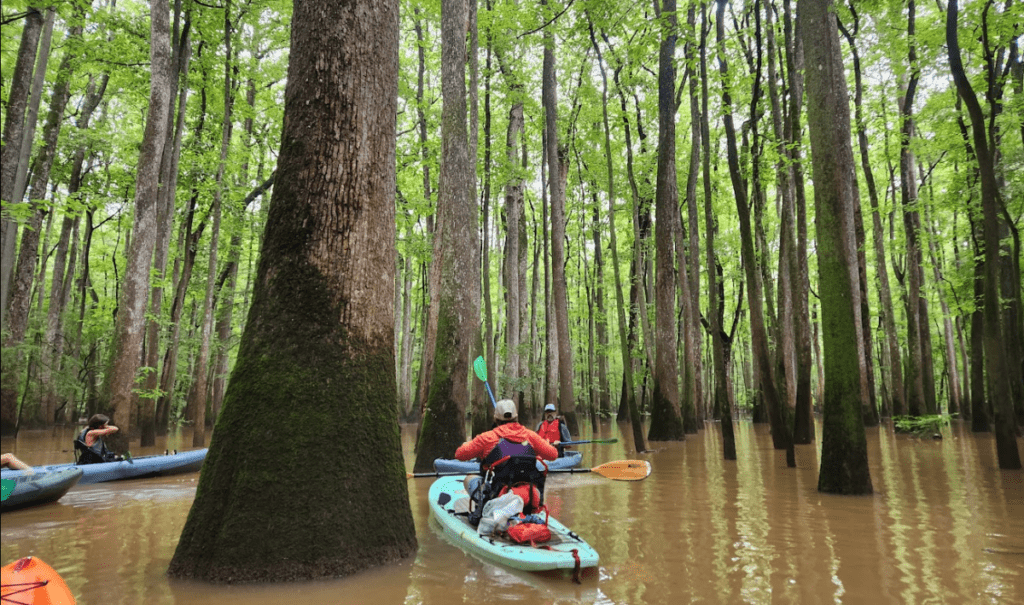
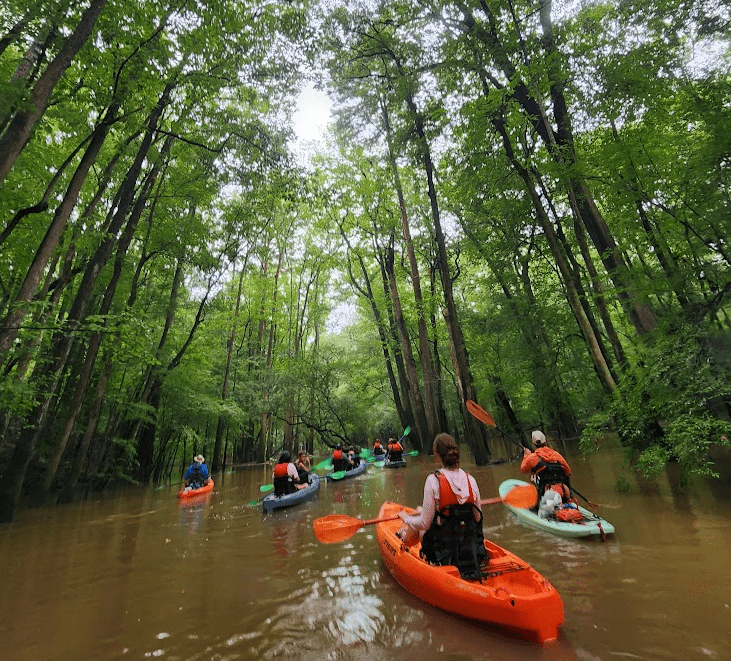
- Kayak Cedar Creek with a Guided Tour. If you have time for one non-hiking thing at Congaree, make it a guided kayak tour. We used Carolina Outdoor Adventures and cannot recommend them enough. The large, winding creek takes you into the heart of the park, and when it is flooded, you can kayak through a grove of tupelo trees.
- Watch the Synchronous Fireflies (May-June). If you plan your trip right, you may be able to witness one of nature’s craziest light shows. Thousands of synchronous fireflies flash in unison after dark. You will have to draw the lottery for access on peak nights, but it’s worth planning your trip around this phenomenon.
- Ranger-Led Programs. The park offers free ranger-led programs like canoe tours, guided hikes, and wildlife programs on a rotating schedule. Make sure to check the park website or call ahead for more information.
- Additional hiking and kayaking opportunities. For the most adventurous, there are more opportunities for hiking and paddling, but these backcountry trails require GPS, reasonable conditions, and a strong will. Some stretches of paddle trail require significant portages depending on water levels, and hiking trails may be washed out or flooded.
- Check out the Harry Hampton Visitor Center. We enjoyed the park film and the exhibits showing the different champion trees in the park. Our favorite was the Possumhaw.
Best Hikes
Hiking at Congaree may be flooded depending on season. These are our favorite trails:
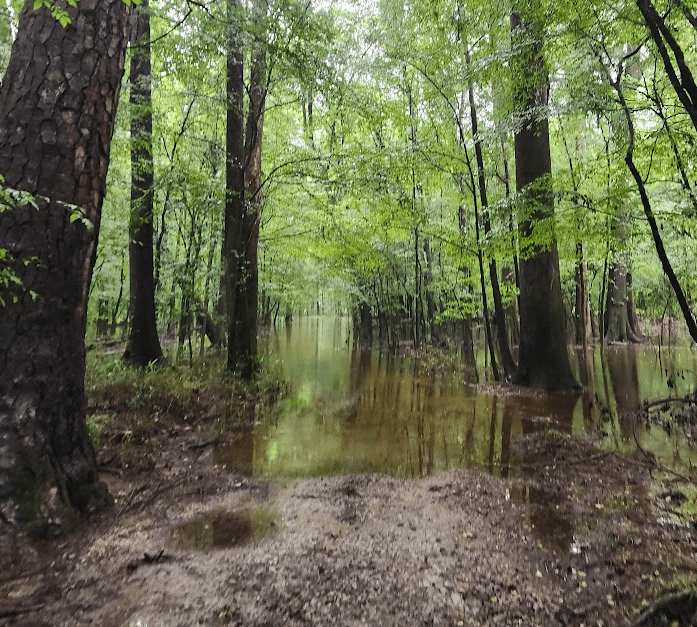
- Boardwalk Loop Trail (2.4 miles, easy-moderate based on flooding,1-2 hours) – This is the park’s most popular and accessible trail. During summer flooding, portions of the lower boardwalk have water.
- Weston Lake Loop Trail (4.7 miles, easy-moderate based on flooding, 2-3 hours) – This trail branches off the boardwalk and loops through deeper floodplain forest to Weston Lake. This is excellent for wildlife spotting, but it is subject to flooding.
- Bluff Trail (2.1 miles, easy, 1 hour) – This is a gentler path through a wooden boardwalk, and it is a good option when the lower trails are heavily flooded.
- River Trail (11.1 miles, moderate, 4 hours) – This trail leads to the Congaree River and is flat and heavily wooded. It is a more backcountry experience with lots of wildlife and spiders, but it is easy to get lost and may be flooded.
Key Areas in Congaree National Park
Congaree National Park is not huge, but there are still a few areas that you should know about:
- The West End (Harry Hampton Visitor Center Area) – Where most visitors spend their time. The visitor center, frontcountry campgrounds, and Boardwalk Loop Trailhead are all here. The Cedar Creek Canoe/Kayak Launch is also nearby.
- Cedar Creek – The park’s main paddling route, Cedar Creek winds for miles through the interior of the park. The creek is slow-moving and manageable for beginners, but during the flood season it can be a workout to fish the current back upstream. Water levels fluctuate with rainfall, which can affect tour logistics, so talk to your outfitter.
- The East End (US 601 Area) – This portion of the park is less visited, but it offers access to the Bates Ferry Trail and the Congaree River via a separate boat ramp. This is worth exploring on a second visit or if you have multiple days available.
Our Experience at Congaree National Park
My wife and I visited Congaree National Park on a free weekend while we were in the area. Congaree was an add-on, it was not the sole purpose of the trip, so we did not arrive during the optimal season. August was flooded, and the bugs and humidity were crazy. Still, coming from Central Florida, the air and water felt a little cooler than back home.
Paddling Cedar Creek
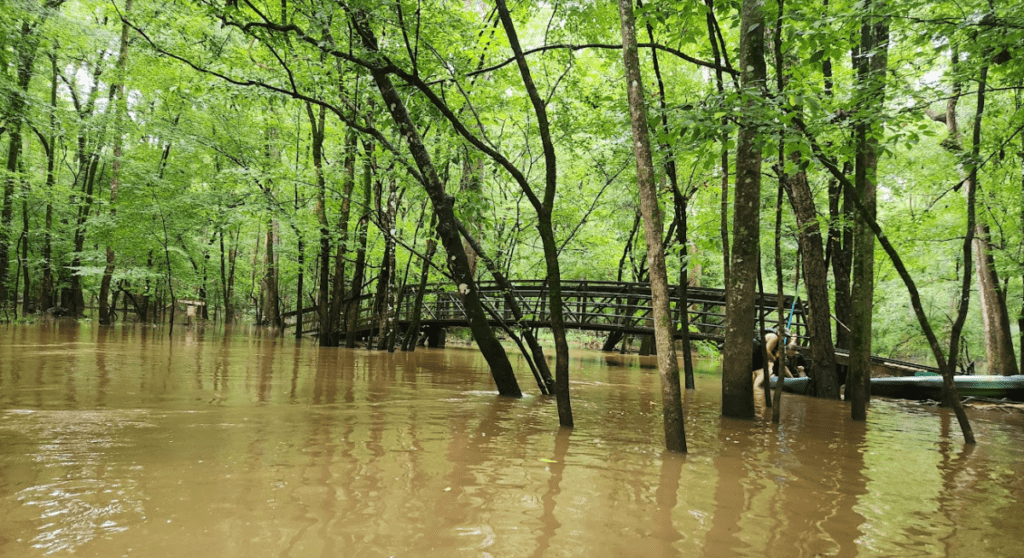
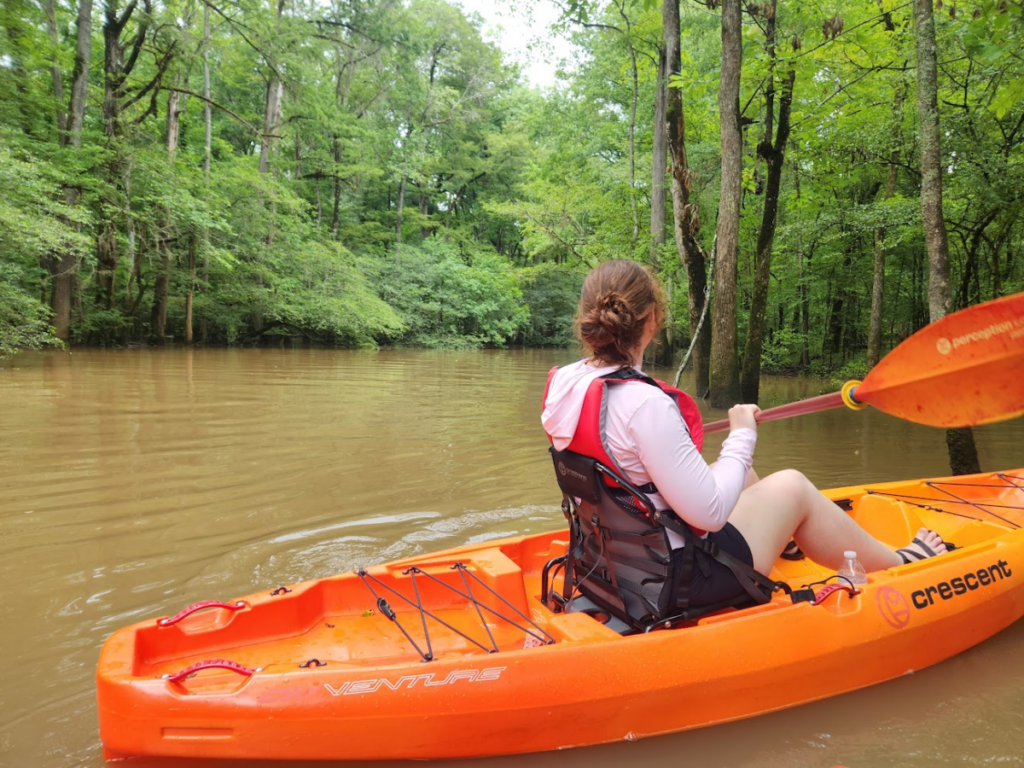
Our day began with a paddle trip down Cedar Creek. We met with our guides from Carolina Outdoor Adventures and went down to the water. We did not have to walk far from the parking lot – the flooded creek extended almost to it. Cedar Creek must have been over 100 feet wide during our visit.
As we began our journey, it was clear that the guide was knowledgeable, funny, and passionate about the park’s ecology and history. While the trail was clear, it was also possible to paddle through the woods. We took a stop at a tupelo basin and spent 15 minutes paddling through the flooded ecosystem. We saw an otter, but were not able to get a picture.
The highlights of the paddle trip for me were the fishing spider sightings. These massive arachnids don’t make webs, they grab fish out of the water. Paddling upstream back to the cars was more challenging than the float downstream, especially since the water was moving from recent rains.

Our lunch pitstop was at the nearby Mr. Bunky’s Market. In the early afternoon, we escaped the rain in the Harry Hampton Visitor Center, where we watched the park film and learned about the champion trees, from Swamp Tupelo to Possumhaw to Loblolly Pine. These are the largest of their species at a given time, some were nationally ranked and some were state ranked. Congaree contains the highest concentration of champion trees in North America.
Hiking the Boardwalk Trail
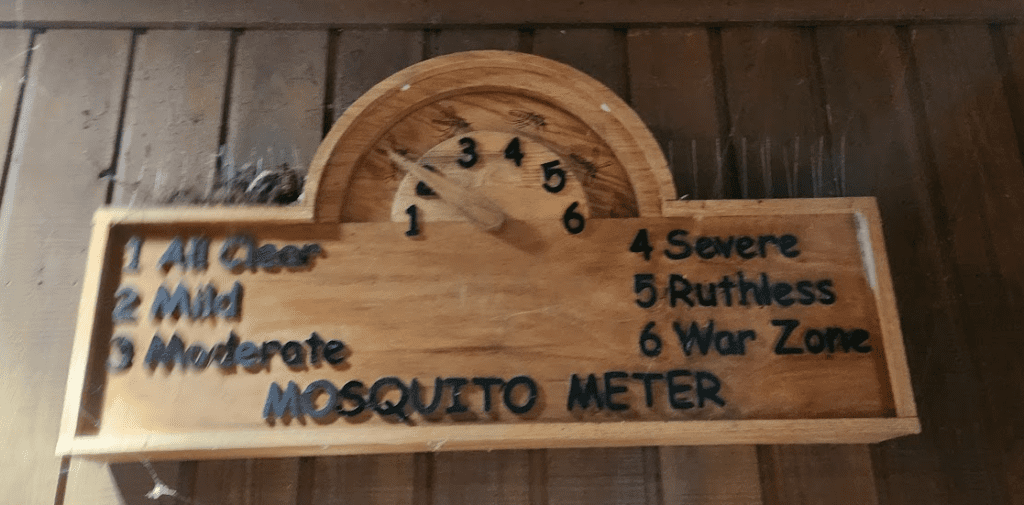
Back outside, the Mosquito Meter was only at a 2, or “Mild” rating. This was a relief. We saw that part of the Boardwalk Trail was flooded, part was closed, and part was open. We decided to hike down the open section and see how flooded the other section really was.
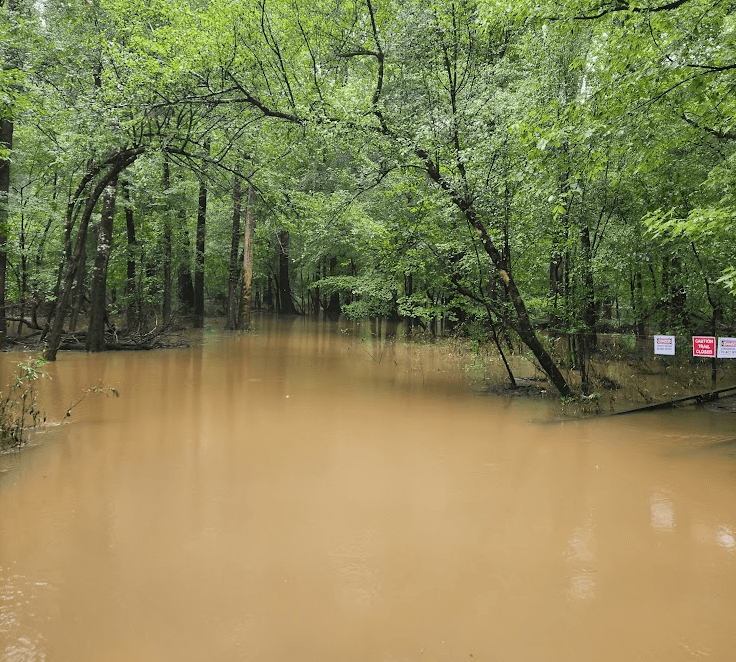
The boardwalk was slightly flooded towards the river, and it was clear the sign was right. Still, we were already wet, so we decided to hike the flooded portion back to the Visitor Center. The rangers at the Visitor Center had indicated that this was allowed, but not recommended and at our own risk. Equipped with a Garmin InReach and a will for adventure, we found the water at the lowest point was around knee deep, but it quickly receded as we traveled back to the Visitor Center. The trail had a hard bottom and was easy to follow.
This park felt like a safer version of the flooded swampland we hunt in Florida. The alligators are generally smaller, the water is cooler, and there are fewer snakes. There were a comparable amount of bugs, and I got attacked by some sort of bee-looking insect on the way back.
Don’t Make Our Mistake
We visited in August and met flooded trails. In the future, we would see this park when the water is receded. I think it would be fun to do an end-to-end paddle trip to see more of Cedar Creek and the Congaree River.
What We Would Do Differently
The next time we visit, it will be during mid-May the synchronous fireflies are in season.
If not during the synchronous fireflies, we would visit in October for fall colors and lower water levels.
How To Visit in One Day
- 9:30 AM – Kayak Cedar Creek
- 1:00 PM – Lunch at Mr. Bunky’s Market
- 2:00 PM – Check out the Harry Hampton Visitor Center and watch the park film
- 2:30 PM – Hike the 2.4-mile Boardwalk Trail
- 3:30 PM – Hike the Bluff Trail to see a different part of the park, or depart and head to Columbia for dinner
If You Only Do One Thing
Walk the Boardwalk Loop Trail. This trail captures the essence of the park and is the most rewarding and iconic way to do a quick trip. Pick up a tour brochure first and hike counterclockwise. Look for gators at the overlook.

Where to Eat Near Congaree National Park
There are no food options inside the park and there are limited options nearby.
Our best recommendation is to eat lunch at Mr. Bunky’s Market & Restaurant. This is an old-timey general store, full-service restaurant, meat market, hardware store, and thrift store, all in one. South Carolinians have been eating here since the 1980s, and the fried chicken plate and flounder sandwich did not disappoint. It is close to a nearby base, and at lunch time it is crowded with men and women in uniform.

Another great lunch option would be JD’s Place in Gadsden. At the time of this writing it is open Mon-Sat from 6:30am – 3:00pm.
There are a lot of dinner options in Columbia. Our favorite is The Hollow, serving wild game preparations like elk filet and venison tartare. For a more budget friendly option, try Tupelo Honey.
Where to Stay Near Congaree National Park
There is no lodge or hotel inside the park, but primitive camping is available at Longleaf Campground and Bluff Campsite. Both require a permit from the visitor center. Camping inside a national park floodplain forest would be a special experience if you are prepared for it.
For conventional lodging, Columbia is your best bet. There are a lot of hotel chains in the area:
- SpringHill Suites by Marriott Columbia Near Fort Jackson
- Country Inn & Suites by Radisson, Columbia
- Holiday Inn Express & Suites Columbia–Fort Jackson
- Hampton Inn & Suites Columbia/Southeast–Ft. Jackson
Tips For Visiting Congaree National Park
- Check conditions before you go, as flooding can make trails impassable. Call the park or check the website, and remember the seasonality of this floodplain ecosystem.
- The Mosquito Meter is real. I would be fearful to approach this park in zone 5 (Ruthless) or 6 (War Zone). If it is a 4 (Severe) or higher, maybe wear long sleeves, a head net, and a lot of bug spray.
- Wear water shoes like Chacos or Tevas. The boardwalk may be flooded or wet, and the kayaking necessitates proper footwear. You don’t want to get your nice trail runners soaking wet.
- Bring water. In the summer it gets hot.
- There’s no food in the park. Pack snacks or plan to head over to Mr. Bunky’s for lunch.
- Book your kayak tours in advance. You can register online ahead of time.
- Dogs are allowed on the Boardwalk Trail and most hiking trails with a leash. We saw a couple on our hike.
- The boardwalk is best in the morning, when wildlife is most active. This is also the time you will want to do your kayak tour.
- Cell service can be spotty, so download offline maps ahead of time.
- The entrance is free.
- Flooding regularly closes trails.
- Synchronous fireflies appear in mid-May.
When to Visit Congaree National Park
Congaree National Park is open 365 days a year, 24 hours a day. The Harry Hampton Visitor Center is open daily from 9 AM to 5 PM.
We recommend visiting in October through November or during the synchronous fireflies in mid-May.
Here is what the park is like in each season:
- Spring: Mild temperatures, lush green vegetation. Rainy season with frequent floods, synchronous fireflies and mild mosquitos.
- Summer: Hot and humid with afternoon thunderstorms common. Bug activity is heavy, yet there are somehow high crowds.
- Fall: Comfortable daytime temperatures and lower humidity. Lower rainfall, so hiking is better. Fall colors begin in late October and early November. This is a great time for paddling.
- Winter: Mild and cool. The park is serene and the canopy is open, making it easier to spot wildlife. This is the best time to dodge crowds and bugs.
Always check the Congaree National Park website or call for the most up-to-date information and water conditions.
What To Bring to Congaree National Park
- Bug spray, especially from April through October
- Head net on heavy mosquito days
- Water, a lot in summer
- Snacks or packed lunch
- Water shoes that you can hike in (Chacos or Tevas are what we use)
- Lightweight long-sleeve shirts and pants for bug and sun protection
- Sunscreen
- Charged phone with offline maps and a camera
- Small dry bag for the kayak tour
Fees & Reservations
The park is free to enter.
Camping requires a permit – backcountry camping is free, but the Bluff Campground and Longleaf Campground have fees ranging between $10-25 per night. Check the park website for booking information and updated prices.
Guided kayak tours through Carolina Outdoor Adventures cost around $80/person at the time of this writing.
Frequently Asked Questions
Is Congaree a swamp?
No, Congaree National Park is an old-growth floodplain forest. Swamps are permanently covered with water, while Congaree only experiences seasonal, temporary flooding. The park regularly floods when the Congaree and Wateree Rivers overflow their banks, creating the standing water that gives it a swamp-like appearance. The distinction matters because the nutrient-rich flooding is what allows the trees to reach their record-breaking sizes.
Are there alligators at Congaree?
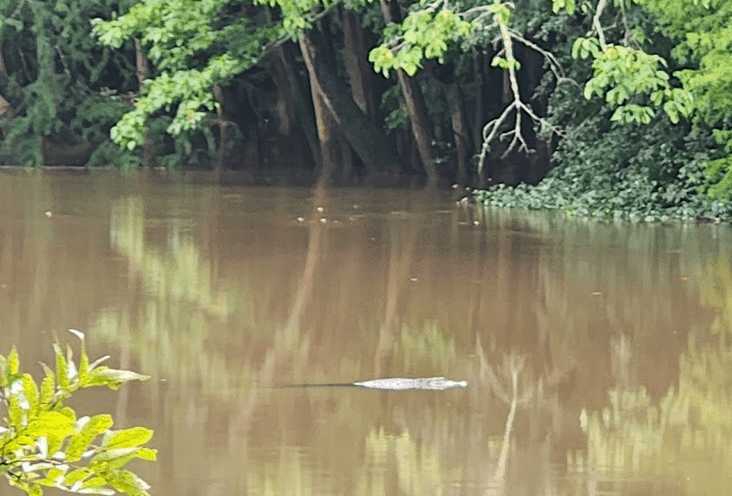
Yes. Alligators are present along Cedar Creek, particularly in summer. They are typically calm and uninterested in humans, but you should maintain a respectful distance and never approach or feed them. Your kayak guide will point them out safely.
Is the boardwalk accessible for wheelchairs and strollers?
The elevated sections of the Boardwalk Loop are wheelchair and stroller accessible. The lower ground-level sections are not, and can be muddy or flooded. Check conditions before visiting.
Can I bring my dog?
Yes, on a leash on most trails including the Boardwalk Loop. Dogs are not permitted on ranger-led programs or inside the visitor center. Carolina Outdoor Adventures allows dogs under 40 pounds on kayak tours with a proper canine PFD.
Do I need to book the kayak tour in advance?
Yes, this is strongly recommended. Carolina Outdoor Adventures is one of a small number of outfitters permitted to operate in the park, and tours fill up, especially on summer weekends. Book online before your trip.
What is the “Mosquito Meter”?
A sign at the Harry Hampton Visitor Center that rates current mosquito activity on a scale of 1 (all clear) to 6 (described as a “war zone”). Check it when you arrive and plan accordingly.
Is there cell service in the park?
Service is spotty and unreliable in parts of the park. Download the NPS app and offline maps before you arrive.
Why Is Congaree a National Park?
Congaree National Park protects the largest remaining expanse of old-growth bottomland hardwood forest in the southeastern United States. The park’s seasonal flooding creates ideal growing conditions for some of the tallest trees in eastern North America, including numerous state and national champion trees. Its unique floodplain ecosystem, rich biodiversity, and scientific importance led to its designation as a national park in 2003.
How Much Time Do You Need at Congaree National Park?
Most visitors can see the highlights of Congaree National Park in half a day by hiking the Boardwalk Loop Trail and visiting the Harry Hampton Visitor Center. To fully experience the park, we recommend spending a full day that includes both hiking and a paddle trip on Cedar Creek. Serious hikers, paddlers, and photographers may want two or more days.
What Is the Best Hike in Congaree National Park?
The Boardwalk Loop Trail is the best hike for most visitors. This 2.4-mile route provides easy access to old-growth forest, giant trees, cypress knees, and seasonal floodwaters. For those looking for a longer hike with fewer people, the Weston Lake Loop Trail is an excellent option.
What Is the Best Time of Year to Visit Congaree National Park?
October through November offers the best combination of comfortable temperatures, lower humidity, reduced mosquito activity, and good hiking conditions. Mid-May is also a popular time to visit because of the park’s famous synchronous fireflies. Summer can be rewarding for paddling but often brings extreme heat, humidity, flooding, and heavy mosquito activity.
Can You Kayak in Congaree National Park?
Yes. Cedar Creek is the park’s primary paddling route and one of the best ways to experience Congaree. Depending on water levels, paddlers can travel through cypress and tupelo forests that are inaccessible by foot. Guided tours are available through permitted outfitters, and experienced paddlers can explore portions of the Congaree National Park Canoe Trail independently.
What Are the Champion Trees at Congaree National Park?
Champion trees are the largest documented examples of a particular tree species. Congaree National Park contains one of the highest concentrations of champion trees in North America, with more than 25 documented champions. Notable species include Swamp Tupelo, Loblolly Pine, Cherrybark Oak, and Possumhaw.
Are Mosquitoes Really That Bad at Congaree National Park?
Yes, especially during late spring and summer. Congaree’s floodplain environment creates ideal breeding conditions for mosquitoes. The park even maintains a famous “Mosquito Meter” outside the visitor center that rates current mosquito activity from 1 (All Clear) to 6 (War Zone). During warmer months, bug spray and lightweight protective clothing are highly recommended.
Is Congaree National Park Good for Families?
Yes. Families will enjoy the easy Boardwalk Loop Trail, wildlife viewing opportunities, ranger programs, and the chance to explore a unique ecosystem unlike most national parks. The park’s flat terrain and relatively short hiking distances make it accessible for children, though families should prepare for bugs and hot weather during summer visits.
Can You See Alligators at Congaree National Park?
Yes. American alligators live within Congaree National Park, particularly along Cedar Creek and other wetland habitats. Sightings are most common during warmer months. While alligators generally avoid people, visitors should maintain a safe distance and never feed or approach wildlife.
Is Congaree National Park Worth Visiting?
Yes, especially if you enjoy wildlife, paddling, forests, and less-crowded national parks. Congaree offers a completely different experience than mountain or canyon parks like Yellowstone or Kings Canyon. Walking among giant trees, exploring flooded forests, and paddling Cedar Creek creates an experience that is difficult to find elsewhere in the United States.
Conclusion
Congaree National Park feels primordial, and it can be intimidating for the uninitiated. This ancient, living forest regularly floods, creating record-sized trees. We visited in August, one of the hottest and buggiest times of year, but still had a fun and memorable trip.
If you travel to Congaree, walk the flooded boardwalk and paddle Cedar Creek. Better yet, play the lottery until you can visit during the synchronous fireflies.
Other Sights Near Congaree National Park
Columbia, South Carolina (20-30 mins) – This is SC’s capital city and it has a good food and arts scene. It is home to the South Carolina State Museum and we would absolutely recommend spending a half-day there.
Sesquicentennial State Park (35 mins) – A local state park with hiking trails, a lake, and camping.
Poinsett State Park (45 mins) – This park combines diverse ecosystems from the foothills region, piedmont region, sandhills, and coastal plain.
Ninety Six National Historic Site (1 hr 45 mins) – This site had a pivotal role in the American Revolution. It hosted the first land battle of the war in the South.
Leave a Reply