

You know that running is good for your health, but did you know that it can also add 3 years to your life? In this post, I will break down the costs of running, to show you that it is a low barrier to entry with a high payoff. You might be new to running, or you might be a seasoned runner. Either way, I hope you find this analysis helpful.
What Gear Do You Need As A Runner?
You do not need a lot of gear to get started running. You do need a pair of dedicated running shoes, and I would recommend also buying a pair of running socks and shorts. Running socks have higher cushion and will help you to prevent blisters. Running shorts tend to have a built-in liner and will help you to reduce chafing.
As a beginner, every other accessory or piece of gear is just noise or people trying to sell you something you do not need. The goal with starting running is to build the habit, and you need to reduce the barrier to entry. To run the Couch to 5K program, you will need a pair of running shoes, and 30 minutes 3 times per week. If you cannot spare 90 minutes a week, here are my recommendations to get your time back.
As you progress in your running journey, you will want more gear. A GPS-enabled watch with heart rate monitoring will allow you to do zone-based workouts. You probably already own wireless earbuds, but they are cheap if you do not (only use one at a time so you can hear cars and other dangers).
As your long runs increase in distance, you may need to supplement with electrolytes and carbs. After my long runs reached 10 miles in length, I started to bring along salt sticks. Honey Stinger or other gels are great for a quick boost as you burn through your glycogen stores.
What Are The Barebones Costs of Running?
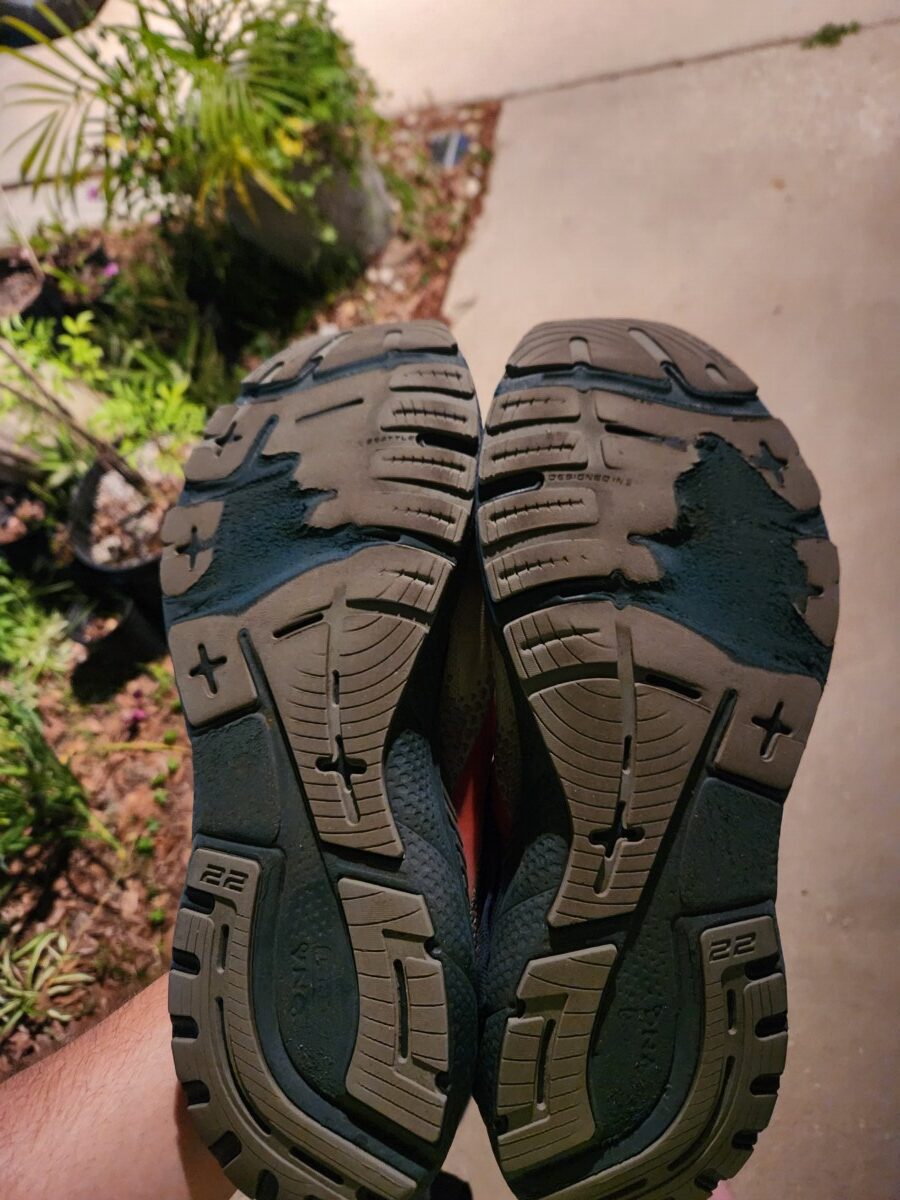
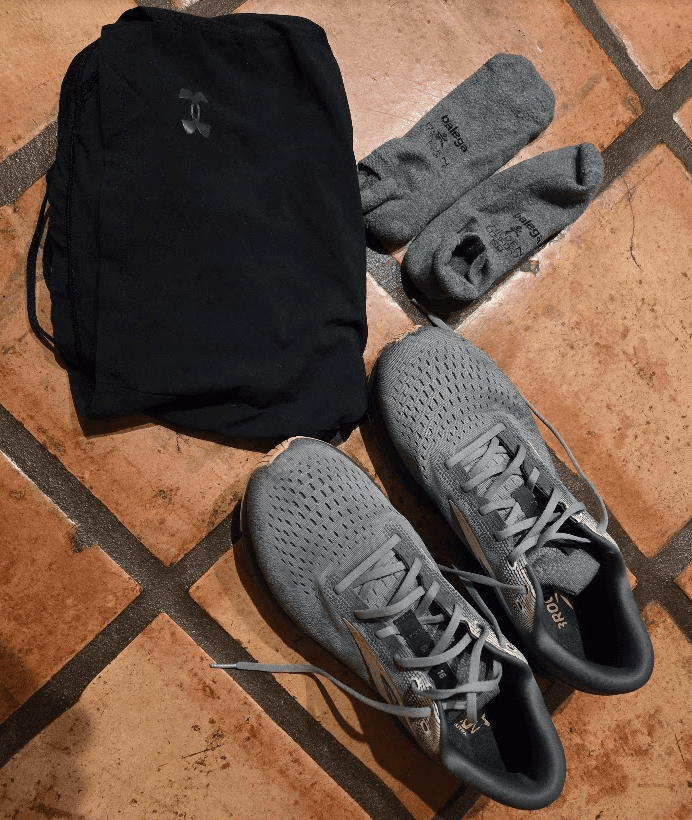
As a Couch to 5K graduate, I remember run/walk intervals of roughly 10 miles per week split into 3 workouts. As you start running, I would recommend a pair of dedicated running shoes (I used Brooks Ghost and Glycerin), a pair of running shorts with a built-in liner, and a pair of running socks. You may want 3 pairs of shorts and socks to accommodate your 3 workouts per week.
Running shoes tend to last between 250-500 miles. I will assume they last on the low end, as your form is not yet dialed in as a beginner. I was pretty overweight when I began my running journey, which increased wear on shoes and decreased their lifespan.
Running shorts are trickier to place a lifespan on. 750 miles is about right from my experience, but this is dependent on the quality of the shorts you pick.
High-quality running socks may last 500 miles or more. I use Balega, and they do a pretty good job keeping me blister free.
Assuming 10 weekly miles for a couch to 5k participant or casual runner, I calculate the cost per mile to be $0.66. This is cheaper than the IRS rate for driving of $0.70!
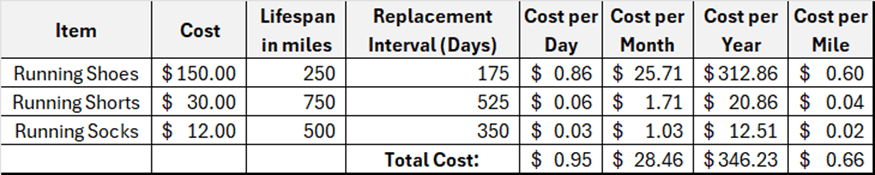
As you can see, running is not expensive. Running 10 miles per week will probably take you around 2 hours per week and cost less than a dollar a day.
What Are The Costs For Intermediate Runners?
You will spend more as an intermediate runner than as a beginner runner. Once you get to this point, you have realized the benefits and running is now part of your lifestyle. You can swallow the costs, because you are reaping the rewards.
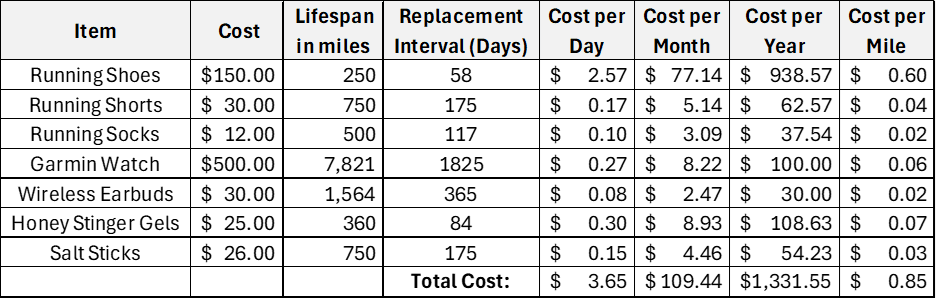
As an intermediate runner, you probably own a smart watch. I use Garmin, and it has been excellent in helping me to stay in the right zone for the workout and automatically track my pace and progress. It has scratches from wearing it in everyday life, and most people tend to keep their Garmins for several years before upgrading. I estimate the lifespan for a mid-range Garmin Watch to be 5 years.
Wireless earbuds cost around $30 for a waterproof set that you can abuse running. I break about a pair a year.
Nutrition becomes more important on longer runs, and you may want a pack of gels or goo for some glycogen when you hit the wall. I personally do one long run a week and eat one pack of honey stinger gels on the run.
Hydration and electrolytes are vitally important especially in the summer. I live in Florida, so I bring Salt Sticks along long runs to get electrolytes and caffeine back in my system. The cost is minimal, and I have found that it decreases my recovery time and increases safety through improving hydration.
I will estimate an intermediate runner as 30 miles per week. Clothing costs are calculated as a function of miles, electronics as a function of time, and snacks and salt sticks are based on the existence of a long run in your training schedule.
As an intermediate runner, I would estimate the costs as $0.85 per mile, or $1331 per year. As far as hobbies are concerned, this one is pretty cheap, and it keeps you in shape.
What Are The Benefits of Running?
You read about the costs of running, but what are the potential benefits? By spending less than $350 per year and becoming a casual runner, you could see:
- Improved fitness
- Decrease in body fat
- Reduced mortality risk
- Mental health improvements
- Better sleep
- Improved cognitive function
- Better immunity
The mental clarity and sleep improvements gained through running will likely help you to increase your earnings potential and gain back the money you spent on running tenfold.
What Is A Longer Life Worth To You?
It was found that running any amount (i.e. casually) increased human lifespan by 3 years. Through an investment of $346.23 per year, you can potentially increase your lifespan by 3 years.
The average American lives to be 78.4 years old. By adding on average 3 years to your life through running, this is 81.4 years. If you start running at 25 and run the rest of your life, you will have run 56.4 years. As a casual runner spending $346.33 per year, you will have spent $19,533.01, but got back 3 more years of your life!
What is a day worth to you? If an additional day of your life, spent with loved ones and giving back to the world is worth more than $17.84, you should become a runner.
Summary
Running is inexpensive and can add years to your life. Everybody should do it if they are able. As a casual runner, you can expect to spend around $350/year getting into the hobby and running 10 miles per week. This is money well spent, adding up to 3 years to your lifespan.
Sources:
https://www.cdc.gov/nchs/products/databriefs/db521.htm
https://www.health.harvard.edu/blog/run-long-life-2017052411722
Leave a Reply